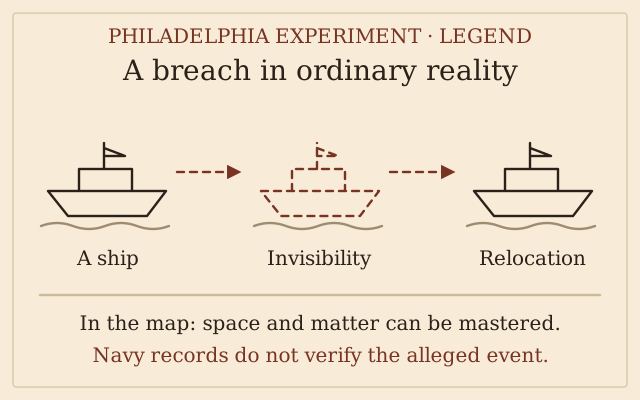
The Philadelphia Experiment gives this map a dramatic beginning for hidden technology: a military ship supposedly disappears and crosses an impossible distance. To understand its role, follow two timelines. One is the date the story assigns to the experiment. The other is the later trail of documents through which people encountered the claim.
A history of the claim and an interpretation of its role in the poster. The diagram illustrates the legend, not a verified experiment.
Keep the dates separate
- 1943Claimed event
The story’s wartime setting
Allende’s later account places a ship-invisibility and relocation experiment in this year.
- 27 August 1943Recorded event
USS Eldridge enters service
The Navy’s ship history records the destroyer escort’s commissioning.
Read the sourcesNaval History and Heritage Command: USS Eldridge (DE-173) ↗ - 1955–1956Publication and correspondence
A claim circulates
ONR traces the story to correspondence after Jessup’s 1955 UFO book and an annotated copy sent to ONR in 1956.
The evidence begins with a story about the past
The Office of Naval Research’s account identifies Morris K. Jessup’s 1955 book The Case for UFO’s as the starting point for the correspondence. A writer calling himself Carlos Allende subsequently described a secret experiment in Philadelphia. In his account, a ship became invisible and travelled to Norfolk and back; he attributed the result to Einstein’s unified-field ideas.
That chronology matters. A letter describing 1943 is evidence that someone later made a claim about 1943. It is not automatically a contemporary record of the alleged event. Keep the claimed date and the date of the surviving account separate when following any hidden-history story.
How an official address can lend a story authority
An annotated copy of Jessup’s book reached ONR in 1956. According to ONR, two officers took a personal interest and arranged a small retyping and reproduction. This documents attention to a text, rather than an institutional finding that teleportation happened.
The distinction is easy to lose when a story is retold: a document being received, copied or kept by an agency can start to sound like an agency validating its contents. For this episode, the office’s own account is valuable precisely because it explains what that involvement amounted to.
A real ship has a different kind of paper trail
USS Eldridge was a real destroyer escort, launched in July and commissioned in August 1943. Its recorded service includes escorting Mediterranean convoys in 1944–1945. The Naval History and Heritage Command says repeated searches have found no documents confirming the alleged Philadelphia event or a Navy effort to accomplish it.
Naval historians also examined the ship’s deck log and war diary. These records are different in purpose from a retrospective paranormal account. The National Archives describes deck logs as chronological records of ship activities. They can help test locations and dates; they should not be represented as an omniscient record of every action or conversation aboard a vessel.
Why the legend belongs on this map
In the poster’s worldview, the ship is a threshold: familiar military machinery appears to break the normal limits of matter and distance. That is our interpretation of its narrative role. It makes a hidden technological achievement imaginable before a reader reaches the map’s larger stories of secret programmes and extraordinary travel.
The linked topics help distinguish versions of that idea. Philadelphia is a retrospective ship legend. The poster’s teleportation entry also concerns alleged beings phasing into or out of ordinary reality. Portals describe supposed passages between places or dimensions. Reading them together explains a family of narratives; it does not make them the same claim or establish that one proves another.
The interesting historical question is how letters, a real vessel and an official institution became ingredients in one enduring story. Their existence does not establish the extraordinary event described by that story.
Continue into the map
These are related reading topics; their order does not imply an additional connection.
Philadelphia Experiment →Teleportation →Stargates & portals →Sources & illustration credit
- Office of Naval Research: Philadelphia Experiment information sheetReference / research
The Navy’s retrospective account of Jessup, the Allende correspondence and the annotated book. This is an institutional account, not a newly examined 1943 experiment log.
- Naval History and Heritage Command: USS Eldridge (DE-173)Reference / research
The ship’s launch, commissioning and recorded wartime service.
- Naval History and Heritage Command: Philadelphia ExperimentReference / research
Summarizes archival searches and the review of Eldridge’s log and war diary; no confirming experiment documents were found.
- National Archives: An introduction to Navy deck logsReference / research
Explains what deck logs record and their limits as historical evidence.
- Champ Parinya: Great Awakening Map, English Lotus V10Belief / proponent source
The poster’s labels and setting. The explanation of their narrative role is the archive’s interpretation.
Original explanatory diagram created for this map; source concepts are credited below. No source image reproduced.