Field notes / Spiritual traditions
Astral travel / out-of-body experience
Real topic · speculative overlay
Meaning, context and sourced connections in the Great Awakening Map.
Locate on the interactive mapIn the map’s worldview
Esoteric interpretation
Astral travel treats the sense of being outside the body as a journey of a subtle self. Its importance here is the possibility that awareness might operate beyond the limits of ordinary embodiment, making the map’s unseen realms personally accessible. That is the esoteric interpretation of the experience. A vivid out-of-body sensation does not on its own establish that consciousness travelled to an independently existing location.
An interpretive reading of the poster and the sources below.
Sources for this interpretation · 2
- Original English V10 — Astral travel / out-of-body experience in the posterBelief / proponent source
Records the poster’s wording and setting; the contextual explanation is an interpretive reading, not an additional factual claim.
- Blanke et al. (2002): Stimulating illusory own-body perceptionsReference / research
Provides a neurological account of out-of-body perception as contrasting background.
Illustrated field note
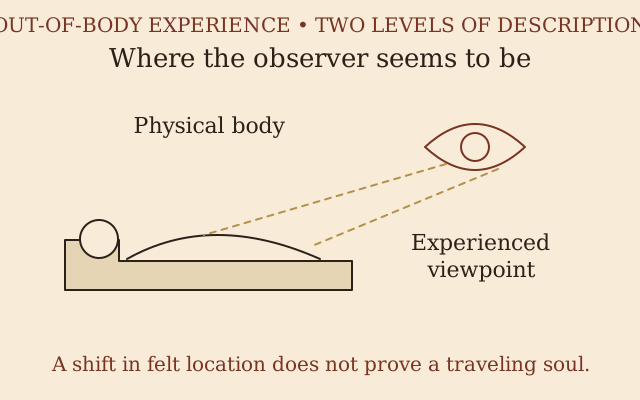
Where the observer seems to be
 Open full-size diagram ↗
Astral-travel traditions interpret a felt separation from the body as a subtle self moving elsewhere. The diagram isolates the experience that makes this interpretation compelling: the apparent viewpoint seems displaced from the physical body. Neurological research shows that body-location experiences can also be altered through brain processes. The map’s spiritual interpretation and a person’s reported experience should therefore be distinguished from evidence of travel to an external realm.
Illustration credit & sources
Original explanatory vector diagram created for this map. Source concepts are credited below; no source artwork reproduced.
Definition & background
The experience or belief of perceiving oneself outside the body; astral traditions interpret this as a subtle body traveling elsewhere.
Evidence & research
Out-of-body experiences are documented, including experimentally induced cases. This does not establish that a separable body or soul physically leaves the person.
Read more
- Blanke et al. (2002): Stimulating illusory own-body perceptionsReference / research
Follow the connections
Related topics
These relationships describe what the map and its cited sources say. A connection does not establish that a claim is true.
Claim made by the poster or its sources
Shamans / shamanism
Astral travel / out-of-body experience is interpreted by McKenna through a shamanic after-death-body model → Shamans / shamanism
McKenna’s New Maps of Hyperspace explicitly discusses an astral-body vehicle and says shamanic practice prepares familiarity with that after-death body. This is his interpretation of a tradition, not a claim that all shamanic cultures share one doctrine.
Sources for this connection
- Terence McKenna: New Maps of Hyperspace (1989)Belief / proponent source