Field notes / Spiritual traditions
Buddha mind / Buddha-nature
Also known as Buddha-nature / Buddha mind
Belief / tradition
Meaning, context and sourced connections in the Great Awakening Map.
Locate on the interactive mapIn the map’s worldview
Esoteric interpretation
The printed Buddhamind label presents awakened awareness as an ideal to realize. Buddha-nature helps explain why such awakening is regarded as possible, but it is not identical to already possessing a Buddha’s fully awakened mind. Within the map, this shifts attention from external rescue to inner potential; it does not mean that every ordinary thought is automatically enlightened or infallible.
An interpretive reading of the poster and the sources below.
Sources for this interpretation · 2
- Original English V10 — Buddha mind / Buddha-nature in the posterBelief / proponent source
Records the poster’s wording and setting; the contextual explanation is an interpretive reading, not an additional factual claim.
- Study Buddhism: Buddha-natureBelief / proponent source
Explains the potential for Buddhahood while preserving the difference from an awakened Buddha’s mind.
Illustrated field note
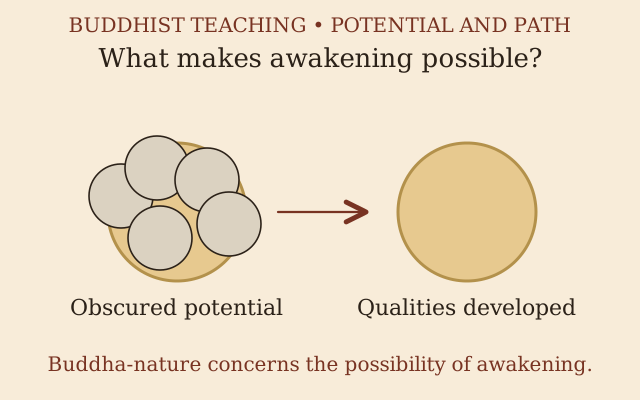
What makes awakening possible?
 Open full-size diagram ↗
Buddha-nature teachings explain why awakening is possible despite confusion and habits. The covered and uncovered discs distinguish obscurations from the potential or qualities developed on the path. Buddhist schools explain these factors differently. The poster’s printed “Buddhamind” names awakened mind; it should not be treated as identical to every technical account of Buddha-nature or as a hidden immortal personality.
Illustration credit & sources
Original explanatory vector diagram created for this map. Source concepts are credited below; no source artwork reproduced.
Definition & background
Buddhamind is the poster’s printed term for an awakened Buddha’s mind. Buddha-nature is the related but distinct teaching about the potential or qualities that make awakening possible for sentient beings. The two terms should not be treated as simple synonyms.
Evidence & research
Different Buddhist schools interpret this differently. It is not simply another name for the chart's creator deity or a universal physical mind.
Reading the original
The original English label reads BUDDHAMIND. The matching Russian adaptation says 'Mind of Buddha.' The existing Buddha-nature explanation remains related background; the two terms are not silently treated as identical.
Read more
- Creator’s original English V10 posterBelief / proponent source
- Study Buddhism: Buddha-natureBelief / proponent source
Follow the connections
Related topics
These relationships describe what the map and its cited sources say. A connection does not establish that a claim is true.
Within a tradition
Enlightenment
Buddha mind / Buddha-nature describes the potential for Buddhahood → Enlightenment
Study Buddhism defines Buddha-nature as factors enabling the attainment of enlightenment.
Sources for this connection
- Study Buddhism: Buddha-natureBelief / proponent source