Field notes / Secret programs
Compartmentalized programs
Real topic · speculative overlay
Meaning, context and sourced connections in the Great Awakening Map.
Locate on the interactive mapIn the map’s worldview
Esoteric interpretation
Compartmentalization explains why the poster’s imagined insiders might each know only one fragment of a much larger system. It supports the idea that secrecy can persist even among participants, allowing conflicting accounts to be placed in different layers. The security principle is real, but it cannot by itself prove that those fragments belong to one extraordinary hidden program.
An interpretive reading of the poster and the sources below.
Sources for this interpretation · 2
- Creator’s original English V10 poster — exact printed wordingBelief / proponent source
Records the poster’s label and its surrounding narrative; the explanation is a contextual reading, not independent confirmation of the claim.
- NIST: compartmentalizationReference / research
Provides the documented identity, history or published work referenced here; it does not validate additional secret-program or esoteric claims made by the poster.
Illustrated field note
Each insider sees only a fragment
 Open full-size diagram ↗
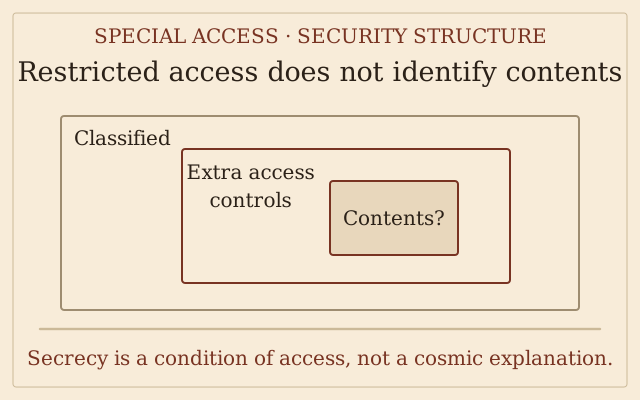
Compartmentalization is the map’s explanation for partial knowledge: a participant could know one project without seeing the entire alleged system. This can organize the story without proving that all reported fragments belong together. The shared nested boundaries illustrate restricted access. They explain the role of secrecy while leaving the actual contents unresolved.
Illustration credit & sources
Original explanatory diagram created for this map; source concepts are credited below. No source image reproduced.
Definition & background
Programs in which access is divided into separate information compartments rather than granted merely by an overall clearance level. The poster uses this real security idea inside its SSP narrative.
Evidence & research
Compartmentalization is documented information security practice; it does not substantiate the claimed off-world activity.
Reading the original
Read directly from the original English V10 poster. Compartmentalized programs is preserved as a distinct printed topic; placement does not itself establish additional relationships.
Read more
- Creator’s original English V10 poster — exact printed wordingBelief / proponent source
- NIST: compartmentalizationReference / research
Follow the connections
Related topics
These relationships describe what the map and its cited sources say. A connection does not establish that a claim is true.
Claim made by the poster or its sources
Secret space program
Compartmentalized programs are an asserted organizational feature of → Secret space program
The English SSP oval explicitly lists compartmentalized programs among its organizational descriptions. The application to these alleged programs is the poster’s claim.
Sources for this connection
- Creator’s original English V10 poster — exact printed wordingBelief / proponent source