Field notes / Ancient worlds & origins
Giza ascension machine
Unsupported claim
Meaning, context and sourced connections in the Great Awakening Map.
Locate on the interactive mapIn the map’s worldview
Esoteric interpretation
The pyramid complex is explicitly recast as a means of spiritual transformation. Architecture becomes active: geometry and place are imagined to help a person move beyond an ordinary condition of consciousness or embodiment. This is the poster’s esoteric function for Giza, not an archaeological finding that the complex operates as a machine or a demonstrated route to ascension.
An interpretive reading of the poster and the sources below.
Sources for this interpretation · 2
- Creator’s original English V10 mapBelief / proponent source
Primary artwork showing Giza ascension machine; supports this reading of the map’s wording and setting, not factual verification of its claims.
- Smithsonian — The Egyptian pyramidReference / research
Provides archaeological background distinct from the function assigned by the poster.
Illustrated field note
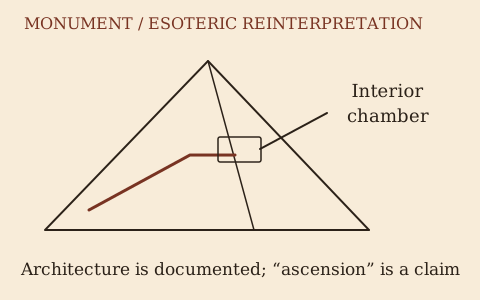
A monument given a second purpose
 Open full-size diagram ↗
The poster recasts Giza as an apparatus for spiritual transformation. Egypt’s antiquities authority describes the Great Pyramid as Khufu’s tomb and documents its chambers and passages. The illustration points toward that architectural reality while keeping the ascension-machine reading in its proper place: it is the map’s esoteric reinterpretation, not an independently demonstrated function of the building.
Illustration credit & sources
Original explanatory diagram created for this map; source concepts are credited below. No source image reproduced.
Definition & background
The poster calls the Giza complex an “Ascension Machine”, implying that its pyramids enable a spiritual transformation.
Evidence & research
The pyramids are real ancient monuments. Their claimed function as an ascension machine is not established by archaeological evidence.
Reading the original
English says GIZA COMPLEX / Ascension Machine. The Russian adaptation substitutes a block-lifting mechanism, which changes the concept.
Read more
- Creator’s original English V10 mapBelief / proponent source
- Smithsonian — The Egyptian pyramidReference / research
Follow the connections
Related topics
These relationships describe what the map and its cited sources say. A connection does not establish that a claim is true.
Claim made by the poster or its sources
Egyptian pyramids
Giza ascension machine attributes an ascension-machine function to the Giza complex → Egyptian pyramids
The original explicitly captions GIZA COMPLEX as Ascension Machine. This states the poster’s proposed function and does not validate it.
Sources for this connection
- Creator’s original English V10 mapBelief / proponent source