Field notes / Spiritual traditions
I Ching / Book of Changes
Belief / tradition
Meaning, context and sourced connections in the Great Awakening Map.
Locate on the interactive mapIn the map’s worldview
Esoteric interpretation
The I Ching offers the map a symbolic language for pattern, change and the relation between a moment and a larger order. Its hexagrams can be read contemplatively or divinationally, making uncertainty seem interpretable rather than meaningless. McKenna’s Timewave Zero adds a separate modern hypothesis to this ancient text; that hypothesis is not simply the traditional meaning of the I Ching.
An interpretive reading of the poster and the sources below.
Sources for this interpretation · 2
- Original English V10 — I Ching / Book of Changes in the posterBelief / proponent source
Records the poster’s wording and setting; the contextual explanation is an interpretive reading, not an additional factual claim.
- Stanford Encyclopedia: Chinese Philosophy of ChangeReference / research
Explains the Book of Changes and Chinese philosophies of change.
Illustrated field note
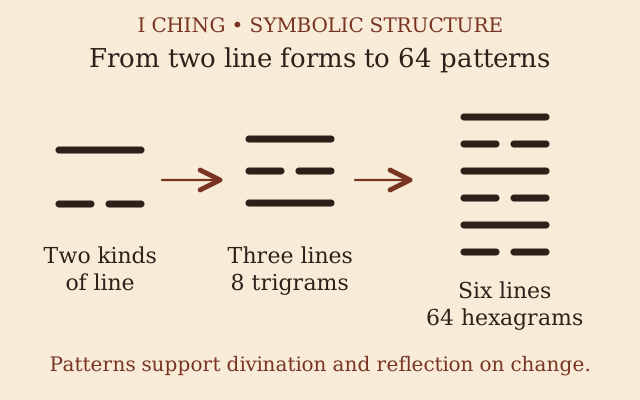
From two line forms to 64 patterns
 Open full-size diagram ↗
The I Ching combines broken and unbroken lines into trigrams and six-line hexagrams. Its interpretive traditions use these patterns to reflect on changing situations and appropriate conduct. In the map, it supplies a symbolic vocabulary for cosmic order and change. McKenna’s Timewave Zero is a later reinterpretation; it is not the traditional meaning of the 64 hexagrams.
Illustration credit & sources
Original explanatory vector diagram created for this map. Source concepts are credited below; no source artwork reproduced.
Definition & background
An ancient Chinese text of divination and philosophy organized around 64 hexagrams, with extensive interpretive traditions.
Evidence & research
The text and its history are well documented. Its use as a physical code of the universe or a predictive timewave is a further esoteric interpretation.
Read more
- Stanford Encyclopedia: Chinese Philosophy of ChangeReference / research
Follow the connections
Related topics
These relationships describe what the map and its cited sources say. A connection does not establish that a claim is true.
Context / documented relationship
Timewave Zero
Timewave Zero derives its pattern scheme from the I Ching → I Ching / Book of Changes
McKenna’s 1998 interview explicitly links his novelty/timewave construction to the I Ching’s 64 hexagrams.
Sources for this connection
- Terence McKenna: Novelty Theory interview, October 1998Belief / proponent source