Field notes / Cosmos & extraterrestrials
19.5° latitude claims
Unsupported claim
Meaning, context and sourced connections in the Great Awakening Map.
Locate on the interactive mapIn the map’s worldview
Esoteric interpretation
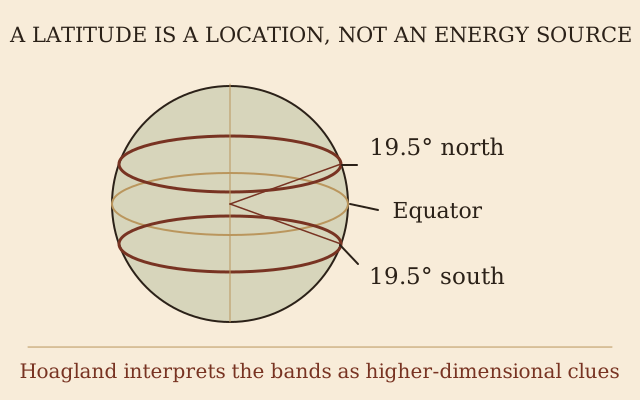
The repeated latitude is offered as a geometric clue to energy arriving from higher dimensions. Its role is to make a hidden physical order appear measurable across different planets. This is Hoagland’s speculative interpretive framework, rather than a general rule that every feature near that latitude is artificial, spiritually charged or part of a single planetary network.
An interpretive reading of the poster and the sources below.
Sources for this interpretation · 2
- High-resolution Russian adaptation — matching text and layoutBelief / proponent source
Records the 19.5° latitude claims label or surrounding claims. The explanation of its narrative role is an interpretive reading.
- Coast to Coast AM — Hoagland and Wilcock discuss 19.5 degreesBelief / proponent source
Identifies the proponents’ higher-dimensional interpretation of planetary latitude.
Illustrated field note
A planetary coordinate acquires a hidden-energy meaning
 Open full-size diagram ↗
In Hoagland’s speculative account, features near 19.5 degrees north or south become evidence of energy arriving from higher dimensions. The coordinate itself is an ordinary angular location measured from the equator. The diagram makes the claimed bands explicit without implying that every nearby feature shares a cause or that a global energy mechanism has been established.
Illustration credit & sources
Original explanatory diagram created for this map; source concepts are credited below. No source image reproduced.
Definition & background
Richard Hoagland’s proposed link between approximately 19.5 degrees of planetary latitude and alleged energy arriving from higher dimensions.
Evidence & research
The cited broadcast records the proposed association. It supplies no independently established physical law that makes these latitudes universal energy portals.
Reading the original
Read in the high-resolution Russian adaptation with matching typography and line breaks; cross-checked with the creator’s English and Russian editions. The source poster documents the wording, not the truth of its claims.
Read more
- Coast to Coast AM — Hoagland and Wilcock discuss 19.5 degreesBelief / proponent source
- High-resolution Russian adaptation — matching text and layoutBelief / proponent source
- Creator’s official Russian poster — alternate translationBelief / proponent source
Follow the connections
Related topics
These relationships describe what the map and its cited sources say. A connection does not establish that a claim is true.
Context / documented relationship
Richard C. Hoagland
19.5° latitude claims is a proposed planetary pattern promoted by Hoagland → Richard C. Hoagland
The 2004 program describes Hoagland and Wilcock discussing the significance they assign to 19.5-degree latitude. This identifies an advocate of the claim, not a demonstrated physical law.
Sources for this connection
- Coast to Coast AM — Hoagland and Wilcock discuss 19.5 degreesBelief / proponent source
Claim made by the poster or its sources
Hyperdimensional physics claims
Hyperdimensional physics claims used to explain alleged planetary anomalies → 19.5° latitude claims
Hoagland interview presents 19.5-degree energy anomalies as higher-dimensional.
Sources for this connection
- Hoagland and Wilcock discuss the proposed physicsBelief / proponent source
- High-resolution Russian poster — source of the diagram’s claimsBelief / proponent source