Field notes / Spiritual traditions
Law of Attraction
Belief / tradition
Meaning, context and sourced connections in the Great Awakening Map.
Locate on the interactive mapIn the map’s worldview
Esoteric interpretation
The Law of Attraction gives the poster’s preferred future a personal analogue: directing attention and intention is supposed to influence what one encounters. Within that worldview, inner orientation matters to outer experience. This is more than the ordinary observation that expectations affect choices. It should not imply that people caused their illness, abuse or hardship through insufficient positivity, or that intention replaces practical action.
An interpretive reading of the poster and the sources below.
Sources for this interpretation · 2
- Original English V10 — Law of Attraction in the posterBelief / proponent source
Records the poster’s wording and setting; the contextual explanation is an interpretive reading, not an additional factual claim.
- Supplied poster — wording of the claimBelief / proponent source
Records the poster’s inclusion of a thought-and-outcome belief.
Illustrated field note
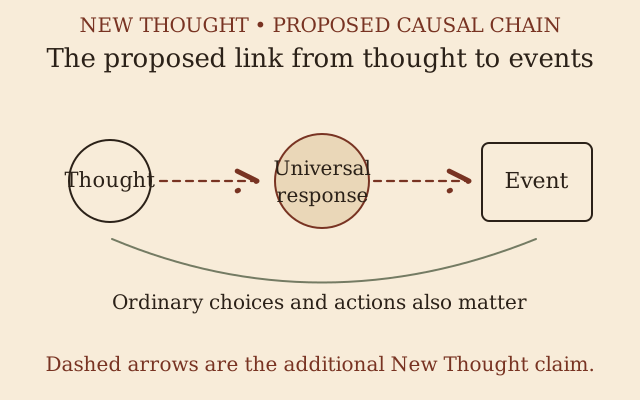
The proposed link from thought to events
 Open full-size diagram ↗
New Thought writers such as Wallace Wattles proposed that a sustained mental image could act upon a universal substance and shape circumstances. This is stronger than the everyday observation that attention influences choices and behavior. The map uses the idea to make inner focus part of world-changing spiritual action. The dashed steps identify the extra metaphysical claim, without implying that unwanted experiences are a person’s fault.
Illustration credit & sources
Original explanatory vector diagram created for this map. Source concepts are credited below; no source artwork reproduced.
Definition & background
The belief that thoughts or mental focus attract matching events into one’s life.
Evidence & research
Motivation can affect behavior, but thoughts are not established to control outside events by a universal attraction law.
Read more
- Supplied poster — wording of the claimBelief / proponent source
- Reference overview: law of attraction in New ThoughtReference / research
Follow the connections
Related topics
These relationships describe what the map and its cited sources say. A connection does not establish that a claim is true.
No specific relationship is currently supported. Nearby placement alone is not treated as a connection.