Field notes / Cosmos & extraterrestrials
NASA image-manipulation claim
Unsupported claim
Meaning, context and sourced connections in the Great Awakening Map.
Locate on the interactive mapIn the map’s worldview
Esoteric interpretation
This allegation explains, within the poster’s story, why a populated and technologically active Solar System might look empty in public imagery. It turns an absence of visible confirmation into a claim about concealment. Recognizing that narrative function is important: lack of confirmation does not itself demonstrate manipulation or identify the supposedly hidden object.
An interpretive reading of the poster and the sources below.
Sources for this interpretation · 1
- Creator’s original English V10 poster — exact printed wordingBelief / proponent source
Records the NASA image-manipulation claim label or surrounding claims. The explanation of its narrative role is an interpretive reading.
Illustrated field note
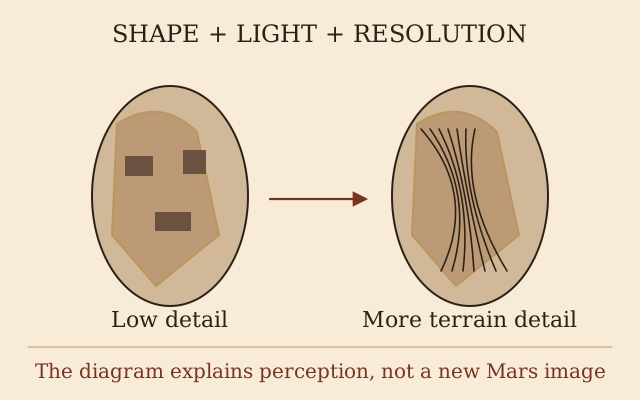
Distinguishing added detail from a concealment accusation
 Open full-size diagram ↗
The poster alleges that NASA alters images to hide anomalies. The Face on Mars example shows why resolution, lighting and processing must be examined before inferring concealment. These invented panels explain the perception issue; they are not evidence that an agency fabricated an image or proof that all processing is neutral.
Illustration credit & sources
Original explanatory diagram created for this map; source concepts are credited below. No source image reproduced.
Definition & background
The poster alleges that NASA manipulates lunar and Martian images to hide anomalies. It also labels satellite/rover blackouts within the Mars panel.
Evidence & research
The claim is about concealment, not the ordinary calibrated processing used to turn instrument measurements into scientific images. The poster supplies no proof of hidden structures.
Reading the original
Read directly from the original English V10 poster. NASA image-manipulation claim is preserved as a distinct printed topic; placement does not itself establish additional relationships.
Read more
- Creator’s original English V10 poster — exact printed wordingBelief / proponent source
Follow the connections
Related topics
These relationships describe what the map and its cited sources say. A connection does not establish that a claim is true.
Claim made by the poster or its sources
NASA
NASA image-manipulation claim alleges concealment by → NASA
The English caption explicitly reads NASA COVERUPS / PHOTO MANIPULATION / Lunar & Martian Anomalies.
Sources for this connection
- Creator’s original English V10 poster — exact printed wordingBelief / proponent source