Field notes / Spiritual traditions
Reality as illusion / nonduality
Belief / tradition
Meaning, context and sourced connections in the Great Awakening Map.
Locate on the interactive mapIn the map’s worldview
Esoteric interpretation
The illusion theme asks the reader to question the apparent separateness of self, world and Source. In the poster’s synthesis, awakening means seeing through a limited perspective, not merely discovering a different physical location. Nondual traditions explain this in different ways: Advaita’s ultimate unity and Buddhist emptiness cannot be treated as a single interchangeable teaching, nor does “illusion” mean suffering is unimportant.
An interpretive reading of the poster and the sources below.
Sources for this interpretation · 2
- Original English V10 — Reality as illusion / nonduality in the posterBelief / proponent source
Records the poster’s wording and setting; the contextual explanation is an interpretive reading, not an additional factual claim.
- Internet Encyclopedia of Philosophy: Advaita VedāntaReference / research
Explains Advaita’s nondual philosophy as one relevant tradition, not a universal doctrine.
Illustrated field note
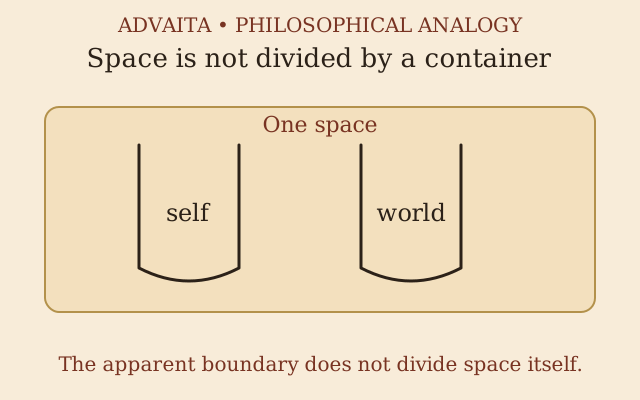
Space is not divided by a container
 Open full-size diagram ↗
An Advaita analogy compares apparent separateness to space inside and outside a container: the boundary makes a distinction without producing two separate kinds of space. This helps explain the poster’s language of seeing through separation and returning to Source. It is one tradition’s reading of nonduality. Buddhist emptiness has a different philosophical framework, and neither teaching means ordinary suffering can simply be ignored.
Illustration credit & sources
Original explanatory vector diagram created for this map. Source concepts are credited below; no source artwork reproduced.
Definition & background
The chart echoes philosophies that question ordinary separateness. For example, Advaita Vedānta teaches that the individual self and ultimate reality are not ultimately separate.
Evidence & research
This is a useful philosophical comparison, not an identification of the chart with Advaita. Buddhist emptiness, Advaita and computer-simulation claims are distinct ideas.
Read more
- Internet Encyclopedia of Philosophy: Advaita VedāntaReference / research
Follow the connections
Related topics
These relationships describe what the map and its cited sources say. A connection does not establish that a claim is true.
Within a tradition
Rigpa
Rigpa is described as nondual awareness → Reality as illusion / nonduality
The poster prints “nondual mind” immediately below “Meditation Rigpa”; this records the poster’s Buddhist vocabulary, not a neuroscience claim.
Sources for this connection
- Matching Russian translation — high-resolution mapBelief / proponent source