Field notes / Awakening & change
Service to others / self
Belief / tradition
Meaning, context and sourced connections in the Great Awakening Map.
Locate on the interactive mapIn the map’s worldview
Esoteric interpretation
Service to others and service to self give the map a moral axis. Spiritual advancement is evaluated through how power and awareness are used: care and cooperation on one side, domination and control on the other. This helps connect its accounts of benevolent beings with everyday conduct. The distinction belongs to the cited teaching; it is not a reliable test for assigning real people to secret cosmic factions.
An interpretive reading of the poster and the sources below.
Sources for this interpretation · 2
- Original English V10 — Service to others / self in the posterBelief / proponent source
Records the poster’s wording and setting; the contextual explanation is an interpretive reading, not an additional factual claim.
- Law of One: Service to others — primary belief sourceBelief / proponent source
Documents the Law of One’s service-to-others orientation.
Illustrated field note
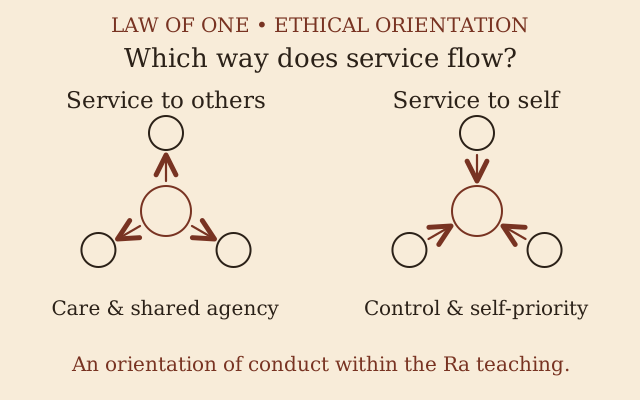
Which way does service flow?
 Open full-size diagram ↗
In the map’s Law of One vocabulary, spiritual development has an ethical direction. Service to others opens the self toward other beings; service to self places the self’s interests at the center. The contrasting networks are an interpretive shorthand for these orientations. They do not provide a test for identifying secret factions or deciding that a real person belongs to a cosmic category.
Illustration credit & sources
Original explanatory vector diagram created for this map. Source concepts are credited below; no source artwork reproduced.
Definition & background
The Law of One contrasts an orientation toward others' welfare with an orientation toward control and self-interest; it calls these spiritual polarities.
Evidence & research
An ethical classification within that teaching. It does not supply evidence that named governments, alien groups or people occupy cosmic 'positive' or 'negative' camps.
Read more
- Law of One: Service to others — primary belief sourceBelief / proponent source
Follow the connections
Related topics
These relationships describe what the map and its cited sources say. A connection does not establish that a claim is true.
Within a tradition
Law of One / Ra material
Law of One / Ra material distinguishes service to others from service to self → Service to others / self
The Ra transcript explicitly contrasts these orientations as spiritual polarities.
Sources for this connection
- Law of One: Service to others — primary belief sourceBelief / proponent source
Within a tradition
Spiritual densities / 3D–9D+
Service to others / self is said to determine eligibility for density transition → Spiritual densities / 3D–9D+
Ra 17.31–17.33 connects service-to-others or service-to-self orientation with qualification for fourth-density harvest.
Sources for this connection
- Law of One 17.29–17.34: polarity and harvestBelief / proponent source
Claim made by the poster or its sources
Reptilians / Draco
Service to others / self assigns service-to-self polarity to the Draco alliance → Reptilians / Draco
The Dark Fleet oval labels its Draco–reptilian alliance as negative beings serving only themselves.
Sources for this connection
- Matching Russian translation — high-resolution posterBelief / proponent source
Claim made by the poster or its sources
Dark Fleet
Dark Fleet is assigned a service-to-self orientation → Service to others / self
At the top of the Dark Fleet oval, the poster labels the faction as negative beings serving only themselves.
Sources for this connection
- Matching Russian translation — high-resolution mapBelief / proponent source
Within a tradition
The Blue Avian Message
The Blue Avian Message teaches the service-to-others orientation of → Service to others / self
The primary introduction explicitly makes becoming more service-to-others oriented part of the message.
Sources for this connection
- Sphere Being Alliance: Introduction and Blue Avian messageBelief / proponent source