Field notes / Spiritual traditions
Synchronicity / 11:11
Belief / tradition
Meaning, context and sourced connections in the Great Awakening Map.
Locate on the interactive mapIn the map’s worldview
Esoteric interpretation
Repeated numbers such as 11:11 function here as signs that personal experience belongs to a larger pattern. In the map’s spiritual reading, an apparent coincidence can feel like reassurance, guidance or a prompt to pay attention during awakening. This is meaning attributed to an experience; neither the number pattern nor Jung’s concept establishes that an outside intelligence sent a message.
An interpretive reading of the poster and the sources below.
Sources for this interpretation · 2
- Original English V10 — Synchronicity / 11:11 in the posterBelief / proponent source
Records the poster’s wording and setting; the contextual explanation is an interpretive reading, not an additional factual claim.
- International Association of Analytical Psychology: synchronicityReference / research
Explains Jung’s meaningful-coincidence concept underlying this reading.
Illustrated field note
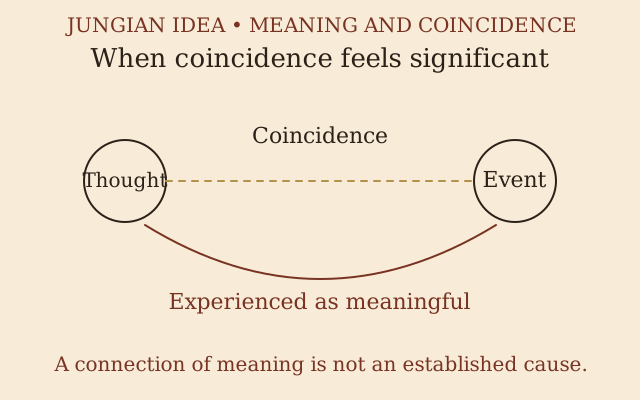
When coincidence feels significant
 Open full-size diagram ↗
Jung used synchronicity for events experienced as meaningfully connected without an ordinary causal explanation. The poster’s 11:11 motif applies this style of interpretation to repeated numbers. The curved link represents the meaning a person experiences; it is deliberately separate from a claim that one event physically produced the other. A striking coincidence does not on its own establish prediction, intention or hidden coordination.
Illustration credit & sources
Original explanatory vector diagram created for this map. Source concepts are credited below; no source artwork reproduced.
Definition & background
Jung's term for coincidences experienced as meaningfully connected without an identifiable causal link. Repeated numbers are often interpreted this way in contemporary spirituality.
Evidence & research
The experience of meaningful coincidence does not by itself demonstrate a message from the universe or an altered timeline.
Read more
- International Association of Analytical Psychology: synchronicityReference / research
Follow the connections
Related topics
These relationships describe what the map and its cited sources say. A connection does not establish that a claim is true.
Claim made by the poster or its sources
Hyperspace
Synchronicity / 11:11 is interpreted by McKenna as overlap with a higher-dimensional realm → Hyperspace
In New Maps of Hyperspace, McKenna describes a supposed merging of dream/hyperspace laws with ordinary reality, then explicitly calls the resulting meaningful coincidences synchronicity. This is his speculative interpretation, not Jung’s definition or experimental evidence.
Sources for this connection
- Terence McKenna: New Maps of Hyperspace (1989)Belief / proponent source