Field notes / Science & technology
Wave–particle duality
Documented topic
Meaning, context and sourced connections in the Great Awakening Map.
Locate on the interactive mapIn the map’s worldview
Role in the map
Duality is useful to the poster because it challenges the expectation that matter must behave like everyday solid objects. It can therefore become a conceptual opening toward a reality richer than appearances suggest. That philosophical invitation is not a demonstration that human intention freely creates outcomes, or that all mystical accounts of matter follow from quantum experiments.
A contextual role, without a separately established esoteric meaning.
Sources for this interpretation · 2
- High-resolution Russian adaptation — matching text and layoutBelief / proponent source
Records the Wave–particle duality label or surrounding claims. The explanation of its narrative role is an interpretive reading.
- OpenStax — University Physics, Wave-Particle DualityReference / research
Explains the real-world subject. The poster’s additional associations are not findings of this source.
Illustrated field note
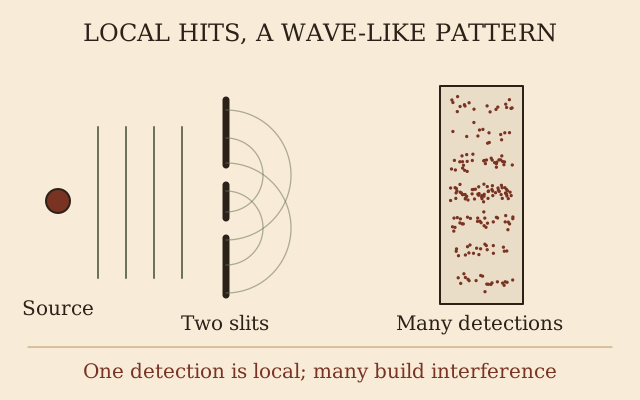
One arrival at a time, an interference pattern
 Open full-size diagram ↗
The poster borrows quantum physics to suggest that reality exceeds ordinary images of solid objects. A double-slit experiment illustrates the actual surprise: individual detections are localized, while many detections can build an interference pattern. Reading this as an opening toward a deeper reality is an interpretation; the experiment does not establish that intention controls external events.
Illustration credit & sources
Original explanatory diagram created for this map; source concepts are credited below. No source image reproduced.
Definition & background
Quantum objects such as electrons and light show wave-like interference and particle-like detection, depending on the experiment.
Evidence & research
This experimentally established behaviour is part of quantum physics. It does not by itself establish consciousness-controlled timelines or spiritual DNA upgrades.
Reading the original
Read in the high-resolution Russian adaptation with matching typography and line breaks; cross-checked with the creator’s English and Russian editions. The source poster documents the wording, not the truth of its claims.
Read more
- OpenStax — University Physics, Wave-Particle DualityReference / research
- High-resolution Russian adaptation — matching text and layoutBelief / proponent source
- Creator’s official Russian poster — alternate translationBelief / proponent source
Follow the connections
Related topics
These relationships describe what the map and its cited sources say. A connection does not establish that a claim is true.
Context / documented relationship
Quantum physics
Wave–particle duality is a core experimentally observed quantum behavior → Quantum physics
The cited university-physics chapter explains interference and particle-like detection as wave–particle duality. This is a defined part of quantum physics.
Sources for this connection
- OpenStax — University Physics, Wave-Particle DualityReference / research