Field notes / Ancient worlds & origins
Atlantis
Belief / tradition
Meaning, context and sourced connections in the Great Awakening Map.
Locate on the interactive mapIn the map’s worldview
Esoteric interpretation
Atlantis supplies an imagined lost chapter in which civilization possessed knowledge that modern humanity has forgotten. Within the poster’s larger cycle of concealment and recovery, its disappearance helps explain why ancient monuments appear to hint at a greater past. This spiritual and technological reading builds on later interpretations of Plato’s story rather than establishing that such a civilization existed.
An interpretive reading of the poster and the sources below.
Sources for this interpretation · 2
- Creator’s English V10 poster — primary artworkBelief / proponent source
Primary artwork showing Atlantis; supports this reading of the map’s wording and setting, not factual verification of its claims.
- Plato — Critias, translated textReference / research
The Platonic source story, distinct from later occult and technological interpretations.
Illustrated field note
Read the city before looking for it
 Open full-size diagram ↗
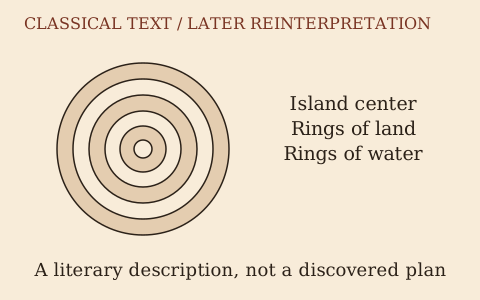
Plato’s Critias describes a central island surrounded by alternating rings of land and water. Later esoteric traditions use Atlantis as an image of lost knowledge or a spiritually and technologically exceptional civilization. The poster participates in that later reuse. This schematic helps readers recognize the literary starting point without presenting Plato’s city as an excavated site or its later technological claims as archaeological findings.
Illustration credit & sources
Original explanatory diagram created for this map; source concepts are credited below. No source image reproduced.
Definition & background
A lost island civilization described in Plato's dialogues, later reworked in occult and alternative-history narratives.
Evidence & research
Plato is the key ancient source. The image's advanced civilization and secret-technology connections are not established by the dialogue.
Read more
- Plato — Critias, translated textReference / research
- Internet Encyclopedia of Philosophy — TimaeusReference / research
Follow the connections
Related topics
These relationships describe what the map and its cited sources say. A connection does not establish that a claim is true.
Claim made by the poster or its sources
Mars / secret colonies
Mars / secret colonies alleged survivors founded → Atlantis
Printed caption claims survivors of a Mars catastrophe built Atlantis.
Sources for this connection
- High-resolution Russian poster — source of the diagram’s claimsBelief / proponent source
Context / documented relationship
Fingerprints of the Gods
Fingerprints of the Gods proposes a lost prehistoric civilization → Atlantis
Hancock’s book page presents a lost advanced prehistoric civilization. The connection is to the lost-civilization interpretation of Atlantis, not an archaeological identification of the legendary place.
Sources for this connection
- Graham Hancock — Fingerprints of the GodsBelief / proponent source
Within a tradition
Emerald Tablets of Thoth
Emerald Tablets of Thoth presents a spiritual narrative about the destruction of → Atlantis
This modern Emerald Tablets interpretation describes Thoth leaving Atlantis after its destruction. It is an occult narrative, distinct from the older singular Emerald Tablet of Hermes and from archaeological evidence.
Sources for this connection
- Atlantis and the Atlanteans: interpretation of the Emerald TabletsBelief / proponent source