Field notes / Cosmos & extraterrestrials
Mars / secret colonies
Real topic · speculative overlay
Meaning, context and sourced connections in the Great Awakening Map.
Locate on the interactive mapIn the map’s worldview
Esoteric interpretation
Mars functions as the map’s concealed second world: a place where ancient catastrophe and alleged modern colonies overlap. It gives the secret-space narrative a concrete destination and extends earthly exploitation into space. The esoteric significance is a hidden human and cosmic history behind the publicly visible planet, rather than a specific mystical quality inherent in Mars.
An interpretive reading of the poster and the sources below.
Sources for this interpretation · 1
- Creator’s original English V10 poster — wording and explicit relationshipsBelief / proponent source
Records the Mars / secret colonies label or surrounding claims. The explanation of its narrative role is an interpretive reading.
Illustrated field note
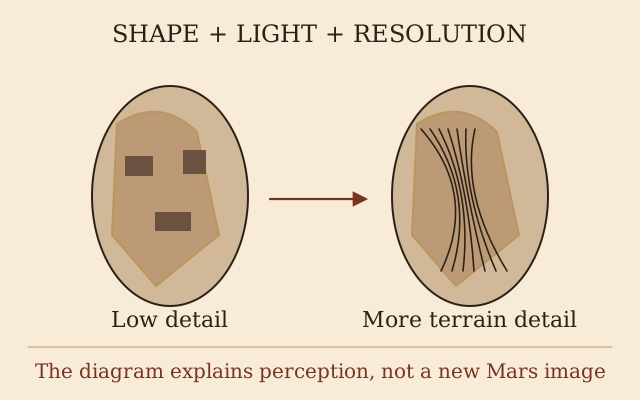
One route from Martian terrain to a hidden-history story
 Open full-size diagram ↗
The poster gives Mars secret colonies, bases and an ancient past. The Face on Mars provides one example of the interpretive move behind that narrative: a striking landform is read as a monument. Improved observations reveal terrain details, while the colony and secret-program allegations require their own evidence.
Illustration credit & sources
Original explanatory diagram created for this map; source concepts are credited below. No source image reproduced.
Definition & background
Mars is a rocky planet explored by robotic missions. The map places hidden colonies and a corporate space program there. Its captions assert human presence since the 1930s, slave colonies, red/blue sky disputes and hidden underground facilities. These are allegations in the poster, not established Mars history.
Evidence & research
Mars exploration is documented; secret human colonies are not independently established. NASA describes robotic exploration as preparation for future human missions.
Read more
- Creator’s original English V10 poster — wording and explicit relationshipsBelief / proponent source
- NASA — Mars exploration overviewReference / research
Follow the connections
Related topics
These relationships describe what the map and its cited sources say. A connection does not establish that a claim is true.
Claim made by the poster or its sources
Interplanetary Corporate Conglomerate
Interplanetary Corporate Conglomerate is alleged to run Martian colonies → Mars / secret colonies
Within the Mars oval, the poster explicitly labels ICC bases and the ICC’s connection to Mars infrastructure.
Sources for this connection
- Matching Russian translation — high-resolution posterBelief / proponent source
Context / documented relationship
Cydonia
Cydonia is a region on → Mars / secret colonies
ESA identifies Cydonia as a region of Mars imaged by Mars Express.
Sources for this connection
- ESA: Cydonia and the Face on MarsReference / research
Claim made by the poster or its sources
Mantids
Mantids are alleged inhabitants of → Mars / secret colonies
The poster lists mantid beings within its Mars panel. This documents the depicted population claim, not a verified Martian species.
Sources for this connection
- High-resolution Russian poster: source for its claims, not proofBelief / proponent source
Claim made by the poster or its sources
Randy Cramer / Captain Kaye
Randy Cramer / Captain Kaye claims military service on → Mars / secret colonies
Cramer’s public interview narrative includes alleged service on Mars. This is an autobiographical extraordinary claim, not a verified deployment.
Sources for this connection
- Emery Smith: interview with Randy CramerBelief / proponent source
Context / documented relationship
Phobos monolith
Phobos monolith stands on Mars’s moon Phobos → Mars / secret colonies
The planetary-science conference proceedings describe the prominent Phobos boulder as an exploration target. Its relation to Mars is through the moon it orbits, not evidence of artificial construction.
Sources for this connection
- Lunar and Planetary Institute — Phobos and Deimos conference proceedingsReference / research
Claim made by the poster or its sources
Maldek
Maldek alleged participants in an ancient war → Mars / secret colonies
Caption says Maldek + Mars, ancient war, 500 thousand years ago.
Sources for this connection
- High-resolution Russian poster — source of the diagram’s claimsBelief / proponent source
Claim made by the poster or its sources
Atlantis
Mars / secret colonies alleged survivors founded → Atlantis
Printed caption claims survivors of a Mars catastrophe built Atlantis.
Sources for this connection
- High-resolution Russian poster — source of the diagram’s claimsBelief / proponent source
Claim made by the poster or its sources
Egyptian pyramids
Mars / secret colonies alleged survivors built on Earth → Egyptian pyramids
Same caption explicitly includes pyramids.
Sources for this connection
- High-resolution Russian poster — source of the diagram’s claimsBelief / proponent source
Claim made by the poster or its sources
20 and back
20 and back alleged term of colony service → Mars / secret colonies
Mars slave-colony caption names the 20-and-back program.
Sources for this connection
- High-resolution Russian poster — source of the diagram’s claimsBelief / proponent source
Claim made by the poster or its sources
Aries Prime — alleged Mars base
Aries Prime — alleged Mars base is alleged to be a corporate base on Mars → Mars / secret colonies
English prints ARIES PRIME / Mars Base; the 2016 interview publication also identifies the named claimed colony as Martian.
Sources for this connection
- Creator’s original English V10 posterBelief / proponent source
- Tony Rodrigues interview, part 3: Aries Prime — claimant accountBelief / proponent source
Claim made by the poster or its sources
Inner Mars civilizations
Inner Mars civilizations are alleged to inhabit the interior of → Mars / secret colonies
The Mars circle expressly labels Inner Mars Civilizations, making the claimed location explicit.
Sources for this connection
- Creator’s original English V10 poster — exact printed wordingBelief / proponent source