Field notes / Cosmos & extraterrestrials
Death Star comparison
Real topic · speculative overlay
Meaning, context and sourced connections in the Great Awakening Map.
Locate on the interactive mapIn the map’s worldview
Esoteric interpretation
The Death Star works as a borrowed visual comparison for extraordinary engineered worlds or weapons. A familiar fictional object makes the poster’s large cosmic claims easy to imagine. It is a cultural reference within the map’s storytelling, not an independent source of information about Saturn’s moons or evidence that a fictional narrative discloses literal secret history.
An interpretive reading of the poster and the sources below.
Sources for this interpretation · 1
- Matching Russian translation — high-resolution mapBelief / proponent source
Records the Death Star comparison label or surrounding claims. The explanation of its narrative role is an interpretive reading.
Illustrated field note
A fictional name borrowed for a real moon
 Open full-size diagram ↗
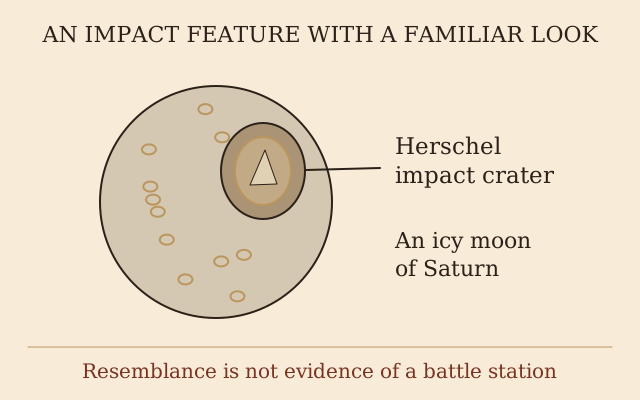
“Death Star” brings a familiar science-fiction image into the poster’s cosmic conflict. Mimas’s large crater makes the visual comparison especially easy. The poster also applies the idea to Iapetus and a Saturn-ring weapon; the diagram illustrates the Mimas resemblance, not evidence that any of these objects is a battle station.
Illustration credit & sources
Original explanatory diagram created for this map; source concepts are credited below. No source image reproduced.
Definition & background
In Star Wars, the Death Star is a fictional battle station capable of destroying planets. The poster applies this name to Mimas and Iapetus and borrows it for a claim that Saturn’s rings form a resonant weapon.
Evidence & research
The Death Star belongs to fiction. The poster’s comparisons and weapon claims do not establish that natural moons or Saturn’s rings are constructed weapons.
Reading the original
Mimas is captioned 'Death Star,' Iapetus 'Ancient Death Star,' and the Saturn oval refers to resonant Death Star weaponry in the Russian image. These repeated references share one explanatory entry.
Read more
- Matching Russian translation — high-resolution mapBelief / proponent source
- Star Wars Databank: Death Star — fictional sourceReference / research
Follow the connections
Related topics
These relationships describe what the map and its cited sources say. A connection does not establish that a claim is true.
Context / documented relationship
Mimas
Death Star comparison is the poster’s fictional comparison for → Mimas
The Mimas label is directly followed by “Death Star.”
Sources for this connection
- Matching Russian translation — high-resolution mapBelief / proponent source
- Star Wars Databank: Death Star — fictional sourceReference / research
Context / documented relationship
Iapetus
Death Star comparison is the poster’s fictional comparison for → Iapetus
The Iapetus caption reads “Ancient Death Star.”
Sources for this connection
- Matching Russian translation — high-resolution mapBelief / proponent source
- Star Wars Databank: Death Star — fictional sourceReference / research
Claim made by the poster or its sources
Saturn's rings
Saturn's rings are imagined as a resonant weapon like → Death Star comparison
The Saturn oval says the rings were created as a resonant Death Star weapon; a fictional phrase is repurposed as an unsupported cosmic claim.
Sources for this connection
- Matching Russian translation — high-resolution mapBelief / proponent source
- Star Wars Databank: Death Star — fictional sourceReference / research
Context / documented relationship
Galactic Empire / Star Wars comparison
Galactic Empire / Star Wars comparison uses this weapon in the fictional story → Death Star comparison
The official Star Wars Databank identifies the Death Star as a weapon of the Galactic Empire.
Sources for this connection
- Star Wars Databank: Galactic Empire — fictional sourceReference / research
- Star Wars Databank: Death Star — fictional sourceReference / research