Field notes / Cosmos & extraterrestrials
Iapetus
Real topic · speculative overlay
Meaning, context and sourced connections in the Great Awakening Map.
Locate on the interactive mapIn the map’s worldview
Esoteric interpretation
The poster’s Death Star comparison asks the reader to see Iapetus as potentially engineered rather than only geological. Its unusual appearance becomes an invitation to distrust ordinary surface explanations and imagine an ancient technological origin. That is a narrative use of the moon’s appearance, not a conclusion that follows from its ridge or contrasting terrain.
An interpretive reading of the poster and the sources below.
Sources for this interpretation · 1
- Creator’s English V10 poster — topic and surrounding narrativeBelief / proponent source
Records the Iapetus label or surrounding claims. The explanation of its narrative role is an interpretive reading.
Illustrated field note
An unusual surface invites an artificial-world story
 Open full-size diagram ↗
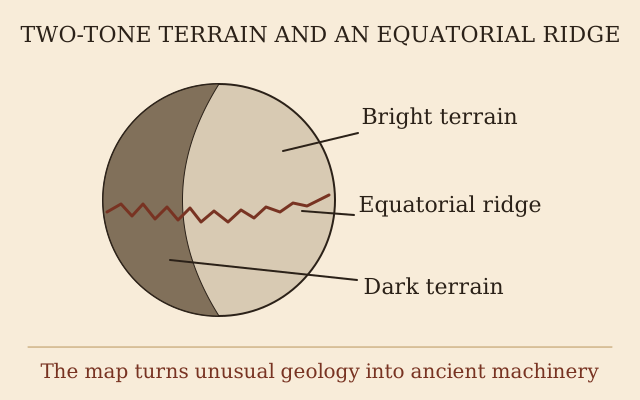
Iapetus contributes two memorable features to the poster’s ancient-technology reading: sharply contrasting terrain and a ridge near its equator. These are observed geological features whose formation is studied through competing natural explanations. The map’s Death Star comparison interprets their appearance as engineering; that inference does not follow from the features alone.
Illustration credit & sources
Original explanatory diagram created for this map; source concepts are credited below. No source image reproduced.
Definition & background
A moon of Saturn known for its sharply contrasting bright and dark terrain and a prominent equatorial ridge. The poster compares it with an ancient Death Star.
Evidence & research
The moon and ridge are documented. An artificial battle-station interpretation has not been established.
Read more
- NASA: IapetusReference / research
Follow the connections
Related topics
These relationships describe what the map and its cited sources say. A connection does not establish that a claim is true.
Context / documented relationship
Death Star comparison
Death Star comparison is the poster’s fictional comparison for → Iapetus
The Iapetus caption reads “Ancient Death Star.”
Sources for this connection
- Matching Russian translation — high-resolution mapBelief / proponent source
- Star Wars Databank: Death Star — fictional sourceReference / research
Context / documented relationship
Saturn
Iapetus is a moon of → Saturn
The object’s NASA reference identifies it as a natural satellite of Saturn.
Sources for this connection
- NASA: IapetusReference / research