Field notes / Cosmos & extraterrestrials
Face on Mars
Real topic · speculative overlay
Meaning, context and sourced connections in the Great Awakening Map.
Locate on the interactive mapIn the map’s worldview
Esoteric interpretation
The face-like appearance makes Mars seem to mirror humanity or ancient Egyptian imagery. The poster’s sarcophagus caption intensifies that comparison, turning a landform into an imagined cultural link across planets. This is an interpretation of visual resemblance within the chart; it does not establish a burial, constructed monument or shared human-Martian ancestry.
An interpretive reading of the poster and the sources below.
Sources for this interpretation · 1
- Creator’s original English V10 poster — exact printed wordingBelief / proponent source
Records the Face on Mars label or surrounding claims. The explanation of its narrative role is an interpretive reading.
Illustrated field note
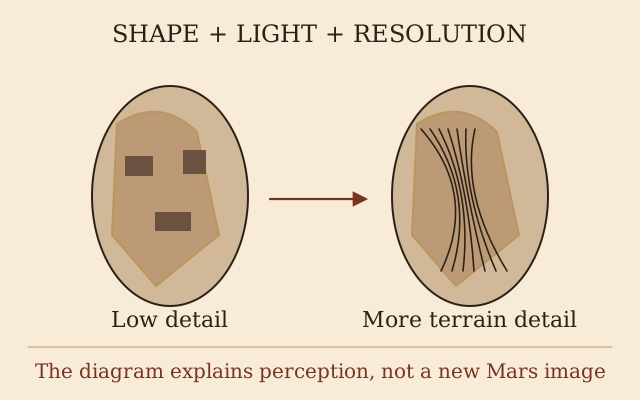
How a landform becomes a familiar face
 Open full-size diagram ↗
The Face on Mars anchors the poster’s reading of Martian terrain as monuments and hidden history. Shadows and limited resolution made a mesa look face-like in an early Viking image; later observations revealed much more geological detail. The diagram explains that interpretive shift without pretending to reproduce a particular photograph.
Illustration credit & sources
Original explanatory diagram created for this map; source concepts are credited below. No source image reproduced.
Definition & background
A Martian mesa that looked face-like in a low-resolution Viking image. The English poster adds the unsupported interpretation “Pharoah Sarcophagus” beneath its Face on Mars label.
Evidence & research
Higher-resolution observations show a natural landform. Lighting and shadows produced the face-like appearance.
Reading the original
Original English prints “Pharoah Sarcophagus” (author’s spelling) as its interpretation of the Face on Mars. This is not a verified archaeological identification.
Read more
- Creator’s original English V10 poster — exact printed wordingBelief / proponent source
- NASA: Face on MarsReference / research
Follow the connections
Related topics
These relationships describe what the map and its cited sources say. A connection does not establish that a claim is true.
Context / documented relationship
Cydonia
Face on Mars is a landform located in → Cydonia
NASA locates the so-called Face on Mars in Cydonia; higher-resolution images show a natural mesa.
Sources for this connection
- NASA: Face on MarsReference / research