Field notes / Spiritual traditions
Flower of Life
Belief / tradition
Meaning, context and sourced connections in the Great Awakening Map.
Locate on the interactive mapIn the map’s worldview
Esoteric interpretation
The Flower of Life turns overlapping circles into an image of creation emerging from unity and remaining interconnected. In this poster it belongs to the idea that spiritual truths can be contemplated through form, alongside sacred geometry and the light vehicle. This is the modern esoteric reading of the pattern; its occurrence as decoration elsewhere does not prove that every maker intended the same cosmology.
An interpretive reading of the poster and the sources below.
Sources for this interpretation · 2
- Original English V10 — Flower of Life in the posterBelief / proponent source
Records the poster’s wording and setting; the contextual explanation is an interpretive reading, not an additional factual claim.
- Seed of Life Institute: Flower of Life teaching history — primary accountBelief / proponent source
Describes the modern teaching lineage associated with the pattern.
Illustrated field note
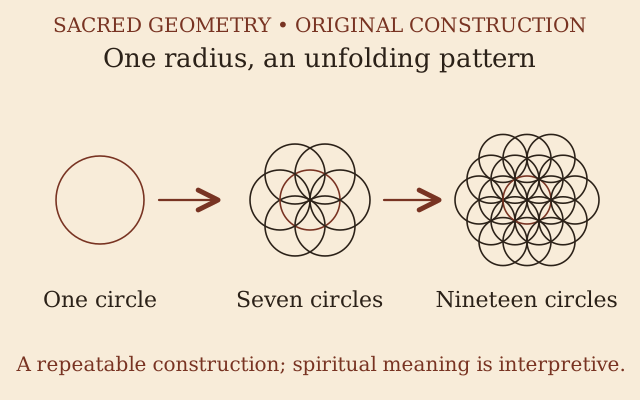
One radius, an unfolding pattern
 Open full-size diagram ↗
Equal circles placed on neighboring centers create a growing network of overlaps. In Drunvalo Melchizedek’s modern teaching, the Flower of Life is interpreted as a pattern of creation, which explains its connection to the map’s sacred geometry and light-body themes. The three stages here are an original geometric construction. Their repeatability is mathematical; the claimed universal spiritual meaning belongs to that modern teaching, rather than following from the circles themselves.
Illustration credit & sources
Original explanatory vector diagram created for this map. Source concepts are credited below; no source artwork reproduced.
Definition & background
A repeating pattern of overlapping circles, used in modern sacred-geometry teachings as a symbol of creation and interconnectedness.
Evidence & research
The pattern is mathematically constructible; claims that it encodes the universe's hidden spiritual mechanisms are interpretations, not consequences of its geometry.
Read more
- Seed of Life Institute: Flower of Life teaching history — primary accountBelief / proponent source
Follow the connections
Related topics
These relationships describe what the map and its cited sources say. A connection does not establish that a claim is true.
Within a tradition
Sacred geometry
Flower of Life is used as a sacred-geometric creation pattern → Sacred geometry
The poster labels its overlapping-circle drawing Sacred Geometry and Flower of Life, explicitly identifying the pattern with that practice.
Sources for this connection
- Matching Russian translation — high-resolution posterBelief / proponent source
Within a tradition
Merkaba / light vehicle
Merkaba / light vehicle is taught within modern Flower of Life practice → Flower of Life
The Seed of Life Institute’s history explicitly says its former Flower of Life curriculum included Merkaba meditation.
Sources for this connection
- Seed of Life Institute: Flower of Life teaching history — primary accountBelief / proponent source
Context / documented relationship
Drunvalo Melchizedek
Drunvalo Melchizedek author of Flower of Life teachings → Flower of Life
The author’s teaching and book series are titled The Ancient Secret of the Flower of Life and discuss that geometrical motif.
Sources for this connection
- Publisher catalogue — Drunvalo MelchizedekBelief / proponent source