Field notes / Spiritual traditions
Merkaba / light vehicle
Belief / tradition
Meaning, context and sourced connections in the Great Awakening Map.
Locate on the interactive mapIn the map’s worldview
Esoteric interpretation
Merkaba is presented as an imagined vehicle or configuration of the light body, making spiritual travel something associated with one’s transformed being. The geometric imagery links meditation, body and cosmic pattern. This modern New Age use differs from historical Jewish chariot mysticism. Reading it in the map’s context therefore requires keeping the modern spiritual-travel claim distinct from the older religious vocabulary it borrows.
An interpretive reading of the poster and the sources below.
Sources for this interpretation · 2
- Original English V10 — Merkaba / light vehicle in the posterBelief / proponent source
Records the poster’s wording and setting; the contextual explanation is an interpretive reading, not an additional factual claim.
- Inner Traditions: Modern MerKaBa teaching — primary accountBelief / proponent source
Describes a modern MerKaBa teaching rather than historical Jewish merkavah mysticism.
Illustrated field note
A vehicle made of spiritual symbolism
 Open full-size diagram ↗
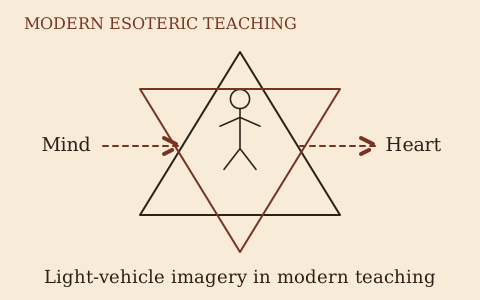
Modern MerKaBa teaching connects meditation, a higher self and a symbolic light vehicle. The poster uses the idea to make spiritual development resemble travel through levels of reality. This plate combines a person, geometric symbolism and a mind–heart connection to illustrate that modern teaching. It does not depict a demonstrated energy field or an engineered transportation device.
Illustration credit & sources
Original explanatory diagram created for this map; source concepts are credited below. No source image reproduced.
Definition & background
In modern New Age teaching, a proposed geometric 'light body' or vehicle for spiritual travel, often linked to meditation and the Flower of Life.
Evidence & research
This modern usage differs from ancient Jewish merkavah, the divine throne-chariot. Neither tradition's symbolism verifies a physical transport technology.
Read more
- Inner Traditions: Modern MerKaBa teaching — primary accountBelief / proponent source
- My Jewish Learning: Historical merkavah mysticismReference / research
Follow the connections
Related topics
These relationships describe what the map and its cited sources say. A connection does not establish that a claim is true.
Within a tradition
Sacred geometry
Merkaba / light vehicle describes a geometric light-body field → Sacred geometry
The publisher’s Beyond the Flower of Life description calls MerKaBa a fifth-dimensional light body activated from a geometric energy field.
Sources for this connection
- Inner Traditions: Beyond the Flower of Life — publisher descriptionBelief / proponent source
Within a tradition
Flower of Life
Merkaba / light vehicle is taught within modern Flower of Life practice → Flower of Life
The Seed of Life Institute’s history explicitly says its former Flower of Life curriculum included Merkaba meditation.
Sources for this connection
- Seed of Life Institute: Flower of Life teaching history — primary accountBelief / proponent source
Within a tradition
Drunvalo Melchizedek
Drunvalo Melchizedek teaches a meditation system involving → Merkaba / light vehicle
Melchizedek’s publisher describes his teachings and books on sacred geometry and Merkaba meditation.
Sources for this connection
- His publisher: Drunvalo Melchizedek and his booksBelief / proponent source