Field notes / Spiritual traditions
Kundalini awakening
Belief / tradition
Meaning, context and sourced connections in the Great Awakening Map.
Locate on the interactive mapIn the map’s worldview
Esoteric interpretation
Kundalini makes awakening an unfolding of latent spiritual potential within embodied life. It gives the map’s transformation theme a traditional vocabulary of practice and realization, alongside chakras and prana. The poster combines this with other systems that have different aims. An unusual sensation or emotional change is not, by itself, a reliable diagnosis of kundalini awakening or evidence that medical concerns can be ignored.
An interpretive reading of the poster and the sources below.
Sources for this interpretation · 2
- Original English V10 — Kundalini awakening in the posterBelief / proponent source
Records the poster’s wording and setting; the contextual explanation is an interpretive reading, not an additional factual claim.
- Himalayan Institute — What Is Kundalini Awakening?Belief / proponent source
Explains kundalini awakening in a yogic teaching context.
Illustrated field note
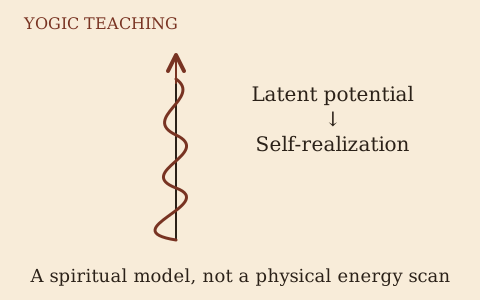
Awakening as the unfolding of potential
 Open full-size diagram ↗
Kundalini language gives personal transformation an image of latent power awakening. Yogic accounts may picture an ascent through subtle centers, while the Himalayan Institute emphasizes self-awakening and self-realization. In this map, that inner movement echoes the larger movement toward cosmic awakening. The curved line symbolizes a teaching; it is not a measured current, and the plate is not an exercise instruction.
Illustration credit & sources
Original explanatory diagram created for this map; source concepts are credited below. No source image reproduced.
Definition & background
In yogic and tantric traditions, the awakening of latent spiritual potential, often interpreted as a process of self-realization.
Evidence & research
This explains a spiritual concept in the language of a living tradition; it is not evidence of the poster’s proposed physical ascension or DNA changes.
Reading the original
Read in the high-resolution Russian adaptation with matching typography and line breaks; cross-checked with the creator’s English and Russian editions. The source poster documents the wording, not the truth of its claims.
Read more
- Himalayan Institute — What Is Kundalini Awakening?Belief / proponent source
- High-resolution Russian adaptation — matching text and layoutBelief / proponent source
- Creator’s official Russian poster — alternate translationBelief / proponent source
Follow the connections
Related topics
These relationships describe what the map and its cited sources say. A connection does not establish that a claim is true.
Within a tradition
Yoga
Kundalini awakening belongs to yogic and tantric practice traditions → Yoga
The Himalayan Institute discusses kundalini awakening within yoga. This supports the historical/practice category, not a measured energy rising in the body.
Sources for this connection
- Himalayan Institute — What Is Kundalini Awakening?Belief / proponent source