Field notes / Spiritual traditions
Yoga
Real topic · speculative overlay
Meaning, context and sourced connections in the Great Awakening Map.
Locate on the interactive mapIn the map’s worldview
Esoteric interpretation
Yoga supplies an embodied route into the map’s spiritual project: breath, attention and disciplined practice join ideas about awakening to something a person does. It connects naturally with the poster’s subtle-body vocabulary, although different yoga traditions have different aims and methods. The map’s cosmic narrative is an additional framework, not something implied by every posture, breathing exercise or historical school of yoga.
An interpretive reading of the poster and the sources below.
Sources for this interpretation · 2
- Original English V10 — Yoga in the posterBelief / proponent source
Records the poster’s wording and setting; the contextual explanation is an interpretive reading, not an additional factual claim.
- NCCIH: Yoga — effectiveness and safetyReference / research
Describes yoga practices and research; it does not substantiate the map’s extraordinary claims.
Illustrated field note
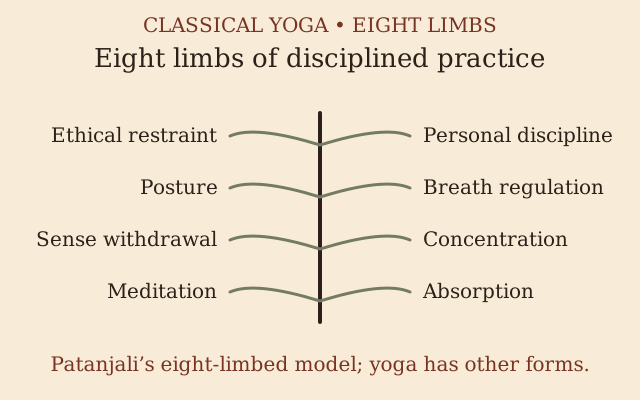
Eight limbs of disciplined practice
 Open full-size diagram ↗
Patanjali’s classical model combines ethical discipline, posture, breath, withdrawal of the senses and increasingly focused contemplation. The branching plant makes clear why yoga occupies a wider spiritual role on this map than physical exercise alone. This is one influential model within a diverse family of traditions. The drawing summarizes relationships and does not prescribe an advanced breathing or meditation routine.
Illustration credit & sources
Original explanatory vector diagram created for this map. Source concepts are credited below; no source artwork reproduced.
Definition & background
A family of Indian spiritual disciplines; contemporary forms commonly combine postures, breathing and meditation.
Evidence & research
Yoga practices and some health benefits are studied. The chart's added claims about supernatural powers, dimensional travel or light bodies require separate evidence.
Read more
- NCCIH: Yoga — effectiveness and safetyReference / research
Follow the connections
Related topics
These relationships describe what the map and its cited sources say. A connection does not establish that a claim is true.
Context / documented relationship
Meditation
Yoga includes meditative practices → Meditation
NCCIH describes yoga as integrating postures, breathing techniques and meditation, with variation among styles.
Sources for this connection
- NCCIH: Yoga — effectiveness and safetyReference / research
Within a tradition
Chakras
Yoga uses chakra models in some traditions → Chakras
The Divine Life Society’s Kundalini Yoga text explicitly explains chakras as part of that yogic subtle-body practice.
Sources for this connection
- The Divine Life Society: Kundalini Yoga — tradition sourceBelief / proponent source
Within a tradition
Om / Aum
Om / Aum is a mantra used in → Yoga
Patanjali’s Yoga Sutras 1.27–1.28 prescribe repetition and contemplation of Om as a yogic practice.
Sources for this connection
- Integral Yoga: Patanjali’s Words — OmBelief / proponent source
Within a tradition
Prana
Prana is the vital-breath concept used in → Yoga
The Yoga Sutra commentary on 2.49 explains pranayama as regulation or expansion of prana, the traditional vital force, through breathing practice.
Sources for this connection
- Pandit Rajmani Tigunait: Yoga Sutra 2.49 commentary, hosted by Sally KemptonBelief / proponent source
Within a tradition
Kundalini awakening
Kundalini awakening belongs to yogic and tantric practice traditions → Yoga
The Himalayan Institute discusses kundalini awakening within yoga. This supports the historical/practice category, not a measured energy rising in the body.
Sources for this connection
- Himalayan Institute — What Is Kundalini Awakening?Belief / proponent source
Within a tradition
Mahabharata / ancient nuclear war
Mahabharata / ancient nuclear war contains teachings on, in the Bhagavad Gita → Yoga
The Bhagavad Gita is part of the Mahabharata and teaches spiritual paths commonly described as forms of yoga. This is a textual relationship, separate from the poster’s ancient-nuclear-war interpretation.
Sources for this connection
- Hindu American Foundation: The Bhagavad GitaBelief / proponent source