Field notes / Spiritual traditions
Lucid dreaming
Documented topic
Meaning, context and sourced connections in the Great Awakening Map.
Locate on the interactive mapIn the map’s worldview
Esoteric interpretation
Lucid dreaming suggests that ordinary experience can be recognized as a constructed or changeable state from within it. In the poster’s contemplative setting, that recognition becomes an analogy for waking up from habitual views of reality. Dream awareness also provides a setting for exploring extraordinary experiences. Verified awareness during dreams does not establish that dream scenes are external worlds or that the dreamer has left the body.
An interpretive reading of the poster and the sources below.
Sources for this interpretation · 2
- Original English V10 — Lucid dreaming in the posterBelief / proponent source
Records the poster’s wording and setting; the contextual explanation is an interpretive reading, not an additional factual claim.
- Konkoly et al. (2021): Real-time dialogue during REM sleepReference / research
Establishes awareness during dreaming; it does not establish travel to independent realms.
Illustrated field note
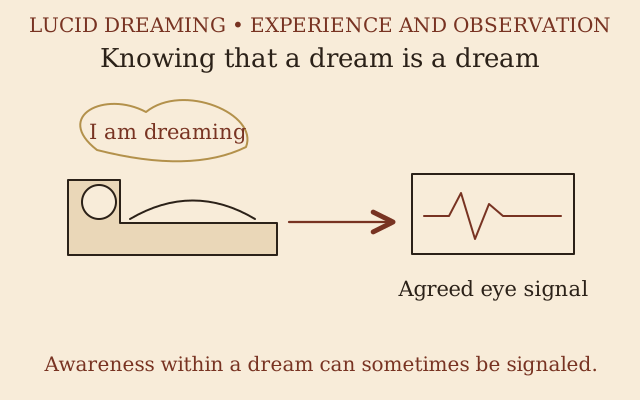
Knowing that a dream is a dream
 Open full-size diagram ↗
Lucid dreaming means recognizing a dream while it continues. That makes it relevant to the poster’s interest in awareness beyond ordinary waking experience. Laboratory studies have recorded agreed signals and, in some cases, exchanges with people during REM sleep. This supports lucid awareness and limited communication during sleep; it does not demonstrate that dream scenes are external realms or that the dreamer has left the body.
Illustration credit & sources
Original explanatory vector diagram created for this map. Source concepts are credited below; no source artwork reproduced.
Definition & background
Being aware that one is dreaming while a dream continues. Researchers have verified instances during REM sleep using prearranged signals.
Evidence & research
A studied sleep phenomenon. Its existence does not demonstrate travel into external spiritual dimensions or access to other people's minds.
Read more
- Konkoly et al. (2021): Real-time dialogue during REM sleepReference / research
Follow the connections
Related topics
These relationships describe what the map and its cited sources say. A connection does not establish that a claim is true.
Within a tradition
Natural light / dream yoga
Natural light / dream yoga is a practice theme within Tibetan dream yoga → Lucid dreaming
Ligmincha’s practice descriptions place clear-light awareness in Tibetan dream and sleep yoga. This is a connection between a traditional practice and awareness during dreaming, not proof of metaphysical light.
Sources for this connection
- Ligmincha: Dream yoga and clear light — Tibetan Bön traditionBelief / proponent source