Field notes / Spiritual traditions
Natural light / dream yoga
Belief / tradition
Meaning, context and sourced connections in the Great Awakening Map.
Locate on the interactive mapIn the map’s worldview
Esoteric interpretation
Natural light points toward awareness that can be explored through sleep and dreaming, rather than a lamp-like substance inside the body. In the map’s contemplative setting, recognizing experience while dreaming becomes related to recognizing the nature of mind. Tibetan Bön and Buddhist practice contexts matter. The term does not mean that every luminous dream proves a light body or travel to a higher dimension.
An interpretive reading of the poster and the sources below.
Sources for this interpretation · 2
- Original English V10 — Natural light / dream yoga in the posterBelief / proponent source
Records the poster’s wording and setting; the contextual explanation is an interpretive reading, not an additional factual claim.
- Ligmincha: Dream yoga and clear light — Tibetan Bön traditionBelief / proponent source
Provides Tibetan Bön dream-yoga and clear-light practice context.
Illustrated field note
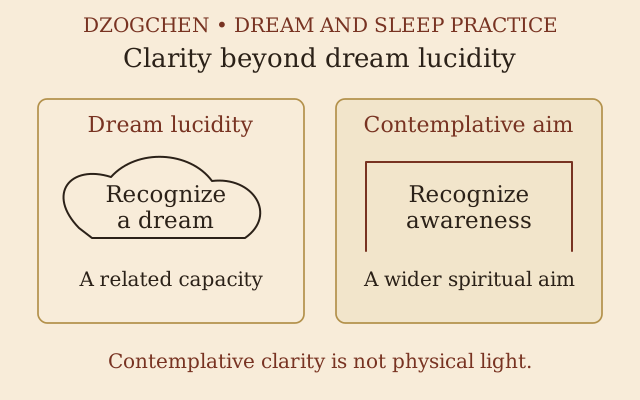
Clarity beyond dream lucidity
 Open full-size diagram ↗
In Chogyal Namkhai Norbu’s Dzogchen presentation, dream practice serves a wider aim of awareness and spiritual liberation. The poster’s natural-light language belongs to this contemplative setting. Recognizing a dream is a related capacity, not the whole teaching. The Bon account cited below also distinguishes dream yoga from sleep yoga, whose aim is clear-light awareness beyond dream imagery. The comparison shows why a laboratory signal from a lucid dream does not establish spiritual realization. Here light refers to contemplative clarity, not radiation emitted by a body.
Illustration credit & sources
Original explanatory vector diagram created for this map. Source concepts are credited below; no source artwork reproduced.
Definition & background
A Tibetan dream-yoga motif relating sleep and awareness to the mind’s natural clarity.
Evidence & research
It describes a contemplative teaching, not ordinary daylight or laboratory optics.
Read more
- Supplied poster — wording of the claimBelief / proponent source
- Ligmincha: Dream yoga and clear light — Tibetan Bön traditionBelief / proponent source
Follow the connections
Related topics
These relationships describe what the map and its cited sources say. A connection does not establish that a claim is true.
Within a tradition
Lucid dreaming
Natural light / dream yoga is a practice theme within Tibetan dream yoga → Lucid dreaming
Ligmincha’s practice descriptions place clear-light awareness in Tibetan dream and sleep yoga. This is a connection between a traditional practice and awareness during dreaming, not proof of metaphysical light.
Sources for this connection
- Ligmincha: Dream yoga and clear light — Tibetan Bön traditionBelief / proponent source