Field notes / Science & technology
Mandela effect
Real topic · speculative overlay
Meaning, context and sourced connections in the Great Awakening Map.
Locate on the interactive mapIn the map’s worldview
Esoteric interpretation
The poster treats a mismatch between memory and records as a possible trace of changing or merging timelines. Its narrative role is to make cosmic transformation feel personally observable: an everyday recollection becomes a clue that reality itself may have shifted. That is the map’s interpretation of the experience, rather than a conclusion established by memory research.
An interpretive reading of the poster and the sources below.
Sources for this interpretation · 1
- Creator’s original English V10 poster — exact small-caption wordingBelief / proponent source
Records the Mandela effect label or surrounding claims. The explanation of its narrative role is an interpretive reading.
Illustrated field note
When many people remember the same difference
 Open full-size diagram ↗
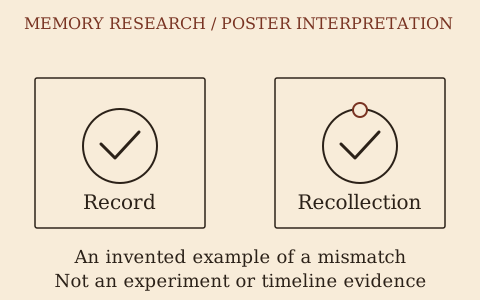
Shared memory errors are a phenomenon that researchers can test. Prasad and Bainbridge found that some familiar images elicited consistent, specific false memories across people. The poster interprets such mismatches through merging timelines. Our invented icon pair illustrates the question without reenacting the experiment: a confident, shared recollection and a surviving record can differ, while the cause still requires investigation.
Illustration credit & sources
Original explanatory diagram created for this map; source concepts are credited below. No source image reproduced.
Definition & background
Shared, confident memories that differ from the available record, such as remembering a logo detail that was never there. The poster interprets the phenomenon as merging timelines. Shared memory differences do not by themselves demonstrate that timelines physically merge.
Evidence & research
Shared false memories have been studied experimentally. The diagram's interpretation involving altered timelines is not established by that research.
Read more
- Creator’s original English V10 poster — exact small-caption wordingBelief / proponent source
- Prasad & Bainbridge: experiments on shared false memoriesReference / research
Follow the connections
Related topics
These relationships describe what the map and its cited sources say. A connection does not establish that a claim is true.
Claim made by the poster or its sources
Time travel
Mandela effect interpreted as converging timelines → Time travel
Caption beside Mandela effect says convergence of timelines.
Sources for this connection
- High-resolution Russian poster — source of the diagram’s claimsBelief / proponent source
Claim made by the poster or its sources
Collective consciousness
Collective consciousness is claimed to cause timeline changes interpreted as → Mandela effect
Goode’s Mandela Effect section attributes reality-merging experiences to collective consciousness. This records his claim, not an established explanation of memory.
Sources for this connection
- Goode and Wilcock: Optimal Temporal Reality (2016)Belief / proponent source
Claim made by the poster or its sources
Optimal timeline reality
Optimal timeline reality uses alleged reality merging associated with → Mandela effect
The same account imagines disclosure arriving through changed realities whose former history is no longer remembered.
Sources for this connection
- Goode and Wilcock: Optimal Temporal Reality (2016)Belief / proponent source