Field notes / Awakening & change
Optimal timeline reality
Belief / tradition
Meaning, context and sourced connections in the Great Awakening Map.
Locate on the interactive mapIn the map’s worldview
Esoteric interpretation
Optimal timeline reality is the future the poster asks its audience to imagine and help create. It combines disclosure, peace and spiritual change into one preferred outcome, making intention feel consequential on a planetary scale. This is not simply optimism about achievable goals: the map adds a metaphysical claim about collective consciousness and timelines. That claim should remain distinct from ordinary planning and cooperation.
An interpretive reading of the poster and the sources below.
Sources for this interpretation · 2
- Original English V10 — Optimal timeline reality in the posterBelief / proponent source
Records the poster’s wording and setting; the contextual explanation is an interpretive reading, not an additional factual claim.
- Corey Goode and David Wilcock: Optimal Temporal RealityBelief / proponent source
Documents Goode and Wilcock’s proposed preferred temporal outcome.
Illustrated field note
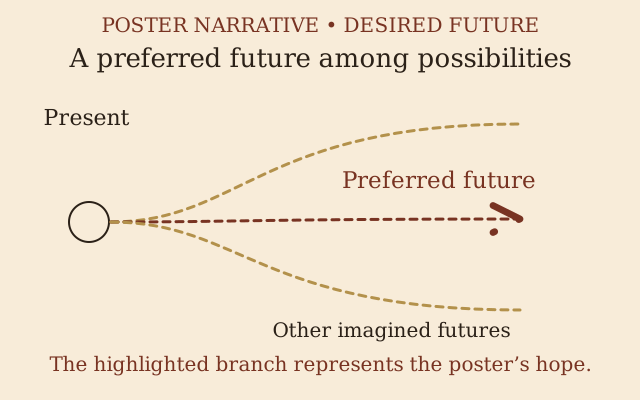
A preferred future among possibilities
 Open full-size diagram ↗
The map’s optimal timeline is a hoped-for future of disclosure and spiritual change. Corey Goode’s account asks people to positively influence shared consciousness as a way toward that outcome. The highlighted path visualizes this claim, while the other branches preserve the idea of alternatives. No measured probability, date or physical mechanism is implied by this illustrative branching.
Illustration credit & sources
Original explanatory vector diagram created for this map. Source concepts are credited below; no source artwork reproduced.
Definition & background
The preferred future of disclosure and spiritual change that the poster says humanity can collectively choose. A caption attributes the production of this preferred reality to worldwide collective meditation.
Evidence & research
This is a spiritual and speculative narrative; the cited account does not demonstrate that thought selects a physical timeline.
Read more
- Creator’s original English V10 poster — wording and explicit relationshipsBelief / proponent source
- Corey Goode and David Wilcock: Optimal Temporal RealityBelief / proponent source
Follow the connections
Related topics
These relationships describe what the map and its cited sources say. A connection does not establish that a claim is true.
Claim made by the poster or its sources
Project Looking Glass
Project Looking Glass allegedly observes alternative futures → Optimal timeline reality
The primary interview account describes Looking Glass as a purported way to observe future possibilities. This connection interprets the map’s timeline narrative and does not validate future-viewing technology.
Sources for this connection
- Project Avalon — Dan Burisch interviewsBelief / proponent source
Claim made by the poster or its sources
Collective consciousness
Collective consciousness is claimed to manifest → Optimal timeline reality
The central poster sentence explicitly links collective consciousness to manifesting an optimal timeline for Earth. This is the poster’s proposed mechanism.
Sources for this connection
- Matching high-resolution Russian posterBelief / proponent source
- Goode and Wilcock: Optimal Temporal Reality (2016)Belief / proponent source
Claim made by the poster or its sources
Full disclosure
Optimal timeline reality imagines a future of → Full disclosure
Goode’s opening description of the preferred timeline includes full disclosure. The link records that stated scenario.
Sources for this connection
- Goode and Wilcock: Optimal Temporal Reality (2016)Belief / proponent source
Claim made by the poster or its sources
Mandela effect
Optimal timeline reality uses alleged reality merging associated with → Mandela effect
The same account imagines disclosure arriving through changed realities whose former history is no longer remembered.
Sources for this connection
- Goode and Wilcock: Optimal Temporal Reality (2016)Belief / proponent source