Field notes / Ancient worlds & origins
Nazca Lines
Documented topic
Meaning, context and sourced connections in the Great Awakening Map.
Locate on the interactive mapIn the map’s worldview
Role in the map
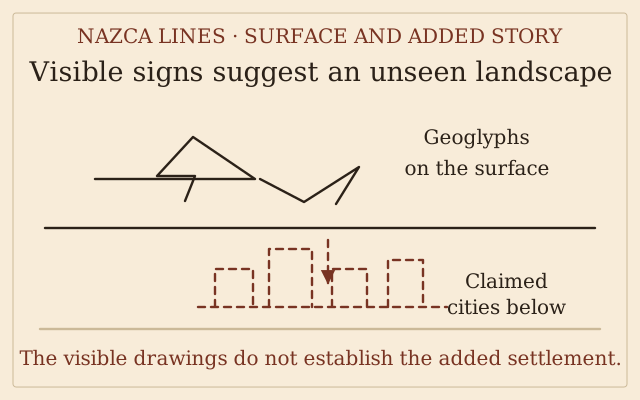
The geoglyphs become surface signs of a supposedly larger hidden landscape. By pairing them with underground cities, the poster treats visible designs as clues to an unseen civilization below. This is the chart’s added narrative connection; documented human creation of the geoglyphs does not establish subterranean settlements or an extraterrestrial purpose for the lines.
A contextual role, without a separately established esoteric meaning.
Sources for this interpretation · 2
- Original English V10 — bottom labels and captionsBelief / proponent source
Primary artwork showing Nazca Lines; supports this reading of the map’s wording and setting, not factual verification of its claims.
- UNESCO: Lines and Geoglyphs of Nasca and PalpaReference / research
Documents the known geoglyphs without establishing the poster’s underground-city addition.
Illustrated field note
The surface becomes a clue to an invisible city
 Open full-size diagram ↗
The Nazca geoglyphs are documented human cultural heritage. The poster adds a second layer by pairing them with underground cities, turning visible designs into supposed signs of a hidden civilization beneath. The illustration separates those layers: the surface drawing is the known category of artifact; the dashed settlement is the map’s additional claim. One does not establish the other.
Illustration credit & sources
Original explanatory diagram created for this map; source concepts are credited below. No source image reproduced.
Definition & background
Large ancient ground drawings in Peru, which the poster links with hidden structures. The English juxtaposition specifically reads “Nazca Lines / Underground Cities”, treating the geoglyphs as associated with an alleged subterranean settlement; it does not provide archaeological evidence for that addition.
Evidence & research
The geoglyphs are human cultural heritage; underground cities are a separate claim.
Read more
- Original English V10 — bottom labels and captionsBelief / proponent source
- Supplied poster — wording of the claimBelief / proponent source
- UNESCO: Lines and Geoglyphs of Nasca and PalpaReference / research

Follow the connections
Related topics
These relationships describe what the map and its cited sources say. A connection does not establish that a claim is true.
Claim made by the poster or its sources
Ancient aliens
Nazca Lines is used as an example in → Ancient aliens
HISTORY’s Ancient Aliens episode Beyond Nazca examines the Nazca Lines through Giorgio Tsoukalos’s ancient-astronaut interpretation. The relationship is documented promotion of that theory, not evidence of alien authorship.
Sources for this connection
- HISTORY: Ancient Aliens season 9 — Beyond NazcaBelief / proponent source