Field notes / Ancient worlds & origins
Ancient aliens
Unsupported claim
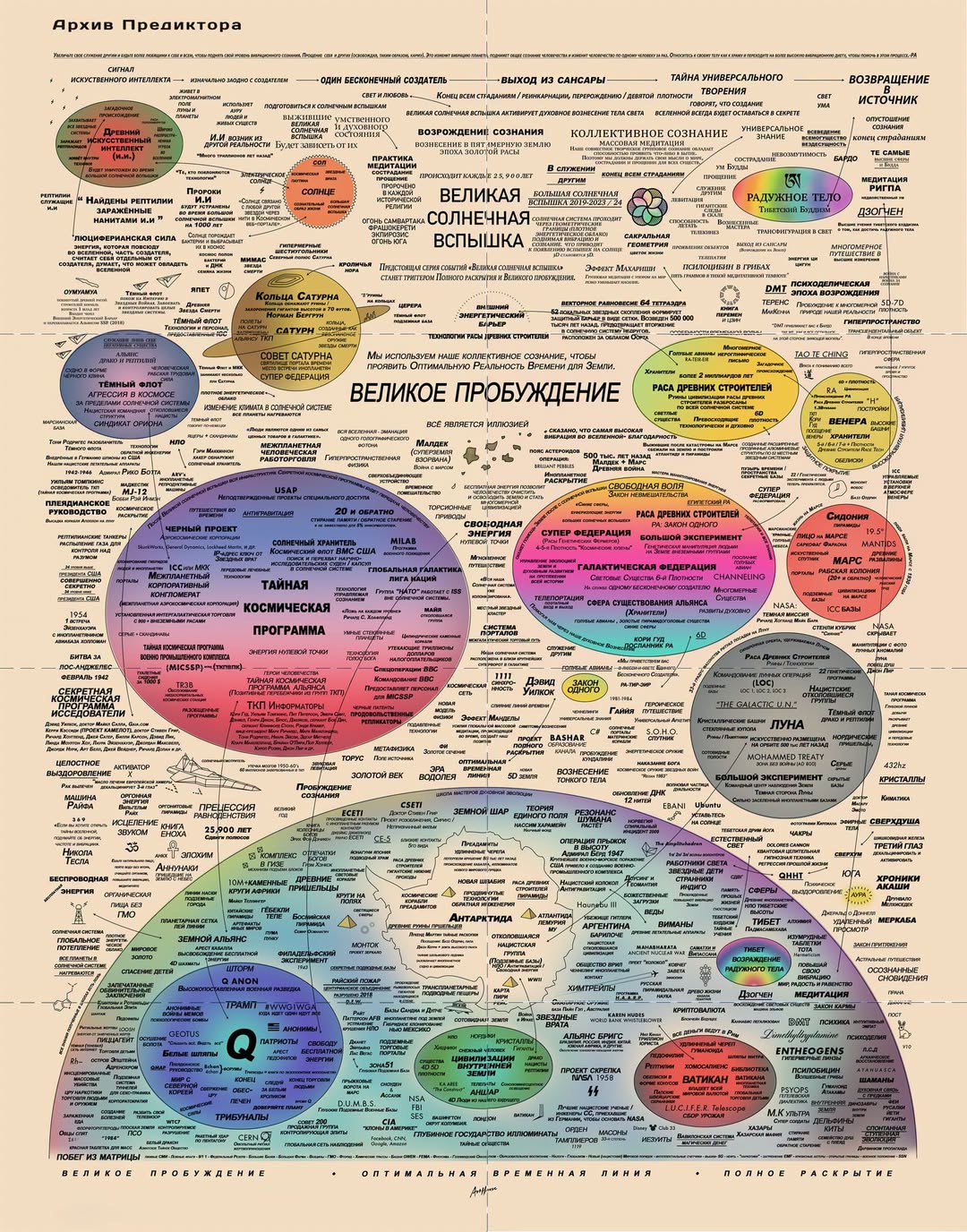
Meaning, context and sourced connections in the Great Awakening Map.
Locate on the interactive mapIn the map’s worldview
Esoteric interpretation
Ancient aliens is the interpretive rule that lets the map read monuments, myths and unusual artifacts as traces of extraterrestrial participation in history. Apparent gaps in ordinary explanations become openings for a cosmic story. Its significance is therefore a proposed way of reading the past, not a single discovery or a demonstrated cause of ancient human achievements.
An interpretive reading of the poster and the sources below.
Sources for this interpretation · 2
- Supplied poster — wording of the claimBelief / proponent source
Primary artwork showing Ancient aliens; supports this reading of the map’s wording and setting, not factual verification of its claims.
- Background on Ancient Builder Race — Sphere-Being Alliance — Ancient Builder Race accountRelated background · not verification
A specific proponent account illustrating the map’s ancient-extraterrestrial narrative.
Illustrated field note
The interpretive rule behind many branches
 Open full-size diagram ↗
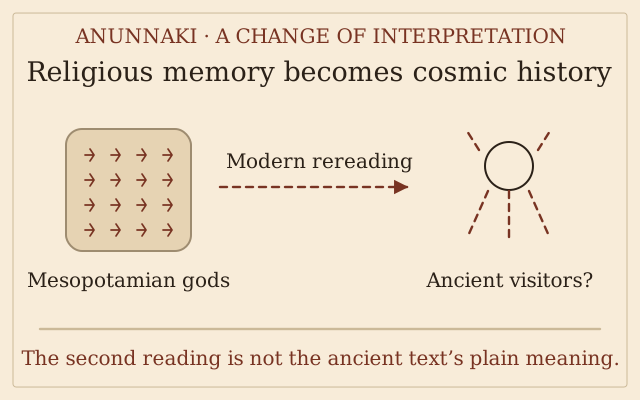
Ancient-astronaut interpretations recast gods, monuments and unusual objects as clues to extraterrestrial involvement in the past. The tablet-to-visitor diagram illustrates one example of that interpretive shift. Its decorative tablet marks are not an ancient inscription, and the diagram does not prove that ancient religious texts describe space travellers.
Illustration credit & sources
Original explanatory diagram created for this map; source concepts are credited below. No source image reproduced.
Definition & background
The proposal that extraterrestrials shaped ancient human cultures and monuments.
Evidence & research
The poster connects archaeology with alien intervention; a claim of intervention requires evidence beyond unusual monuments.
About these sources
The supplied poster is the direct source for this label. The additional reading explains a related topic; it does not independently verify this claim.
Read more
- Supplied poster — wording of the claimBelief / proponent source
- Background on Ancient Builder Race — Sphere-Being Alliance — Ancient Builder Race accountRelated background · not verification
Follow the connections
Related topics
These relationships describe what the map and its cited sources say. A connection does not establish that a claim is true.
Claim made by the poster or its sources
Ancient Builder Race
Ancient aliens is the narrative category containing → Ancient Builder Race
The Ancient Builder Race account attributes ancient ruins and technological works to extraterrestrial civilizations, a specific ancient-astronaut claim.
Sources for this connection
- Background on Ancient Builder Race — Sphere-Being Alliance — Ancient Builder Race accountRelated background · not verification
Context / documented relationship
Chariots of the Gods
Chariots of the Gods popularizes the ancient-astronaut hypothesis → Ancient aliens
The book argues that ancient monuments and traditions preserve evidence of visitors from space; that is the ancient-astronaut hypothesis, not an established archaeological conclusion.
Sources for this connection
- Erich von Däniken — bibliographyBelief / proponent source
Claim made by the poster or its sources
Puma Punku
Puma Punku is used as an example in → Ancient aliens
HISTORY’s Ancient Aliens episode sends ancient-astronaut proponent Giorgio Tsoukalos to Puma Punku. It documents the site’s use in that narrative, not extraterrestrial construction.
Sources for this connection
- HISTORY: Ancient Aliens — The Mystery of Puma PunkuBelief / proponent source
Claim made by the poster or its sources
Nazca Lines
Nazca Lines is used as an example in → Ancient aliens
HISTORY’s Ancient Aliens episode Beyond Nazca examines the Nazca Lines through Giorgio Tsoukalos’s ancient-astronaut interpretation. The relationship is documented promotion of that theory, not evidence of alien authorship.
Sources for this connection
- HISTORY: Ancient Aliens season 9 — Beyond NazcaBelief / proponent source