Field notes / Spiritual traditions
Reincarnation / rebirth
Belief / tradition
Meaning, context and sourced connections in the Great Awakening Map.
Locate on the interactive mapIn the map’s worldview
Esoteric interpretation
Rebirth expands the map’s human story beyond a single lifetime. Identity, learning and unresolved tendencies are imagined as continuing through repeated lives, while liberation offers release from that repetition. The poster combines several versions of this idea. Buddhist accounts do not necessarily posit the same permanent soul assumed in some New Age past-life stories, so those teachings are related without being interchangeable.
An interpretive reading of the poster and the sources below.
Sources for this interpretation · 2
- Original English V10 — Reincarnation / rebirth in the posterBelief / proponent source
Records the poster’s wording and setting; the contextual explanation is an interpretive reading, not an additional factual claim.
- Study Buddhism: RebirthBelief / proponent source
Explains rebirth without requiring an eternal self in Buddhism.
Illustrated field note
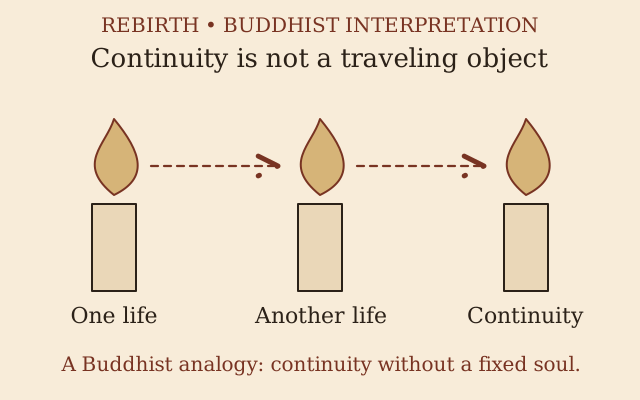
Continuity is not a traveling object
 Open full-size diagram ↗
The poster groups rebirth with karma and freedom from samsara. This original candle analogy highlights a Buddhist distinction: one life conditions another without requiring an unchanging soul to be passed between bodies. Other reincarnation traditions explain personal continuity differently. The dotted links describe a religious account, rather than proof that a remembered scene came from an earlier life.
Illustration credit & sources
Original explanatory vector diagram created for this map. Source concepts are credited below; no source artwork reproduced.
Definition & background
The belief that life continues through successive births. Traditions differ: Buddhist rebirth does not require an eternal, unchanging soul.
Evidence & research
A religious claim. The chart's proposed end of reincarnation is part of its spiritual narrative, not an established future event.
Read more
- Study Buddhism: RebirthBelief / proponent source
Follow the connections
Related topics
These relationships describe what the map and its cited sources say. A connection does not establish that a claim is true.
Within a tradition
Samsara
Samsara is the cycle of repeated rebirth → Reincarnation / rebirth
Study Buddhism defines samsara as uncontrollably recurring existence and rebirth.
Sources for this connection
- Study Buddhism: SamsaraBelief / proponent source
Within a tradition
Karma
Karma is taught to shape experiences of rebirth → Reincarnation / rebirth
The Buddhist account of karma explains actions and their consequences, including effects on later rebirth.
Sources for this connection
- Study Buddhism: KarmaBelief / proponent source
Within a tradition
Bardo
Bardo is an intermediate state before the next birth → Reincarnation / rebirth
The Tibetan Buddhist glossary defines bardo as the interval between death and rebirth.
Sources for this connection
- Study Buddhism glossary: BardoBelief / proponent source
Claim made by the poster or its sources
QHHT / past-life regression
QHHT / past-life regression interprets hypnotic experiences as past lives → Reincarnation / rebirth
QHHT’s own description calls past-life regression a central method and interprets experiences through reincarnation; this does not verify past-life memories.
Sources for this connection
- QHHT: Dolores Cannon and the method (practitioner source)Belief / proponent source
Claim made by the poster or its sources
Lunar soul-catcher claim
Lunar soul-catcher claim is claimed to process souls before → Reincarnation / rebirth
John Lear’s interview describes a lunar soul-processing mechanism tied to return to life on Earth. This is an attributed metaphysical claim.
Sources for this connection
- John Lear — interview describing the lunar soul-processing claimBelief / proponent source
Within a tradition
Past-life recall
Past-life recall is interpreted as memory of earlier incarnations → Reincarnation / rebirth
The University of Virginia research page studies reports interpreted as memories of previous lives. The relationship concerns what the reports claim; it does not establish reincarnation.