Field notes / Spiritual traditions
Third eye / ajna
Belief / tradition
Meaning, context and sourced connections in the Great Awakening Map.
Locate on the interactive mapIn the map’s worldview
Esoteric interpretation
The third eye stands for a way of knowing beyond ordinary sight: insight, intuition or perception of a supposedly hidden reality. Its activation therefore fits the poster’s broader invitation to see through appearances. The map adds a physical decalcification claim to this spiritual symbol. That addition does not make the traditional brow center identical to a medical condition or establish that a treatment will produce spiritual perception.
An interpretive reading of the poster and the sources below.
Sources for this interpretation · 2
- Original English V10 — Third eye / ajna in the posterBelief / proponent source
Records the poster’s wording and setting; the contextual explanation is an interpretive reading, not an additional factual claim.
- The Divine Life Society: Ajna chakra — tradition sourceBelief / proponent source
Explains ajna within a yogic subtle-body account.
Illustrated field note
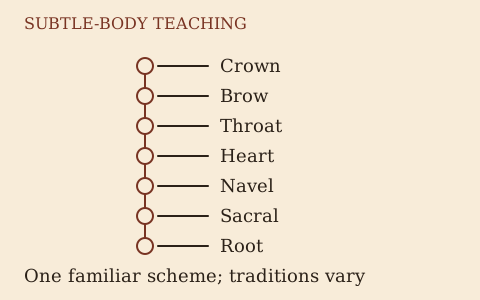
The brow center in a subtle-body model
 Open full-size diagram ↗
In yoga-derived subtle-body systems, the third eye is associated with the brow center, ajna. The shared chart locates that symbolic center among other centers used in practice. It explains the map’s spiritual vocabulary without turning those positions into anatomical organs or proving that pineal-gland activation produces extraordinary perception.
Illustration credit & sources
Original explanatory diagram created for this map; source concepts are credited below. No source image reproduced.
Definition & background
A symbol or subtle-body center associated with insight and spiritual perception; in some yoga traditions ajna is situated at the brow. The poster recommends decalcifying and activating this symbolic eye. Its caption does not establish a medical need or a reliable method for doing so.
Evidence & research
Claims that activating it unlocks paranormal vision go beyond established anatomy. Equating it with the pineal gland does not demonstrate clairvoyance.
Read more
- Original English V10 — bottom labels and captionsBelief / proponent source
- The Divine Life Society: Ajna chakra — tradition sourceBelief / proponent source
Follow the connections
Related topics
These relationships describe what the map and its cited sources say. A connection does not establish that a claim is true.
Within a tradition
Chakras
Third eye / ajna is identified with the ajna chakra in this model → Chakras
The Kundalini Yoga text places Ajna at the brow and describes the spiritual-eye symbolism.
Sources for this connection
- The Divine Life Society: Ajna chakra — tradition sourceBelief / proponent source
Claim made by the poster or its sources
Ratfish liver oil
Ratfish liver oil allegedly decalcifies → Third eye / ajna
The English healing caption specifically names ratfish liver oil as allegedly decalcifying the third eye. It does not substantiate that effect.
Sources for this connection
- Creator’s original English V10 poster — wording and explicit relationshipsBelief / proponent source