Field notes / Spiritual traditions
Chakras
Belief / tradition
Meaning, context and sourced connections in the Great Awakening Map.
Locate on the interactive mapIn the map’s worldview
Esoteric interpretation
Chakras make the body a spiritual landscape. In the map’s awakening story, inner development can be pictured as a change in subtle centers rather than only in thoughts or beliefs. This creates a conceptual bridge to prana, kundalini and the third eye. The poster draws these terms into a modern synthesis; chakra models vary across traditions and are not established anatomical organs.
An interpretive reading of the poster and the sources below.
Sources for this interpretation · 2
- Original English V10 — Chakras in the posterBelief / proponent source
Records the poster’s wording and setting; the contextual explanation is an interpretive reading, not an additional factual claim.
- The Divine Life Society: Kundalini Yoga — tradition sourceBelief / proponent source
Provides a yogic account of subtle centers and their practice context.
Illustrated field note
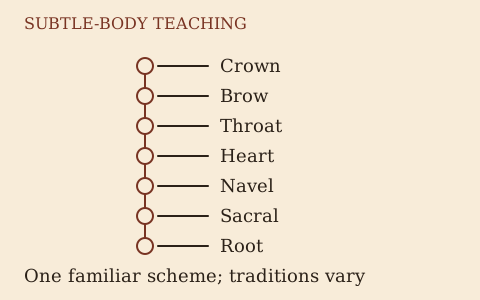
A map of the subtle body
 Open full-size diagram ↗
Chakras locate stages and qualities of spiritual practice within an imagined subtle body. This familiar sequence places six centers along an axis with the crown above; other traditions use different systems. In the poster, these centers connect personal experience with a larger spiritual cosmos. Treat the drawing as a guide to the teaching’s symbolism, not as a chart of seven medically identified organs.
Illustration credit & sources
Original explanatory diagram created for this map; source concepts are credited below. No source image reproduced.
Definition & background
Subtle-body centers used in Hindu, Buddhist and modern esoteric models of spiritual practice; their number and interpretation vary by tradition.
Evidence & research
These are elements of religious physiology, not established anatomical structures. Their traditional meaning differs from measurable nerves, glands or electrical fields.
Read more
- The Divine Life Society: Kundalini Yoga — tradition sourceBelief / proponent source
Follow the connections
Related topics
These relationships describe what the map and its cited sources say. A connection does not establish that a claim is true.
Within a tradition
Yoga
Yoga uses chakra models in some traditions → Chakras
The Divine Life Society’s Kundalini Yoga text explicitly explains chakras as part of that yogic subtle-body practice.
Sources for this connection
- The Divine Life Society: Kundalini Yoga — tradition sourceBelief / proponent source
Within a tradition
Third eye / ajna
Third eye / ajna is identified with the ajna chakra in this model → Chakras
The Kundalini Yoga text places Ajna at the brow and describes the spiritual-eye symbolism.
Sources for this connection
- The Divine Life Society: Ajna chakra — tradition sourceBelief / proponent source