Field notes / Secret programs
20 and back
Unsupported claim
Meaning, context and sourced connections in the Great Awakening Map.
Locate on the interactive mapIn the map’s worldview
Esoteric interpretation
The “20 and back” story makes ordinary biography unreliable inside the map’s narrative: a person could supposedly live a second life without visibly aging or being absent. Memory erasure explains why that life would remain inaccessible, while recovered memories supply the testimony. Esoterically, it dramatizes hidden identity and manipulated time; it should not be treated as a method for interpreting personal memory gaps.
An interpretive reading of the poster and the sources below.
Sources for this interpretation · 2
- Creator’s English V10 poster — printed label and surrounding narrativeBelief / proponent source
Records the poster’s label and its surrounding narrative; the explanation is a contextual reading, not independent confirmation of the claim.
- Sphere-Being Alliance FAQ — claimant’s accountBelief / proponent source
Explains the alleged twenty-year service and return narrative in the claimant’s own material.
Illustrated field note
A second lifetime folded into ordinary life
 Open full-size diagram ↗
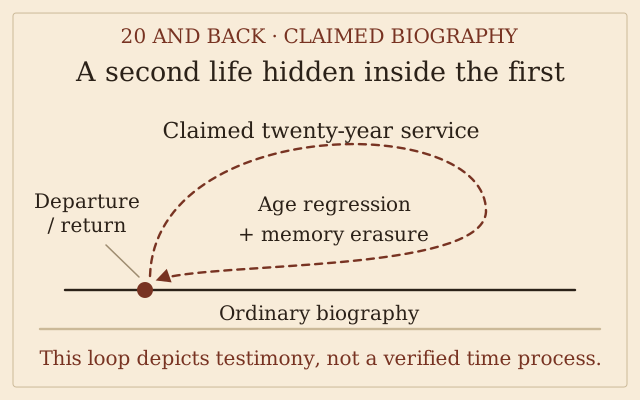
The “20 and back” story claims that a recruit serves off-world, then returns to the departure time with age and memory altered. That loop explains how an extraordinary biography could supposedly remain invisible within an ordinary one. In this map it is a story about hidden identity and manipulated time. The claimed service, memory alteration and return through time are not independently established.
Illustration credit & sources
Original explanatory diagram created for this map; source concepts are credited below. No source image reproduced.
Definition & background
The claim that recruits serve twenty years off-world, then return age-regressed to their original departure time. The poster additionally asserts memory erasure and says it fails for a small minority of alleged informants.
Evidence & research
No independently verified evidence establishes the service, age regression or return through time described.
Read more
- Sphere-Being Alliance FAQ — claimant’s accountBelief / proponent source
Follow the connections
Related topics
These relationships describe what the map and its cited sources say. A connection does not establish that a claim is true.
Claim made by the poster or its sources
Secret space program
Secret space program allegedly uses twenty-year service and age regression → 20 and back
Goode describes twenty-year SSP service followed by age and time regression.
Sources for this connection
- Corey Goode: Sphere-Being Alliance FAQ — claimant accountBelief / proponent source
Claim made by the poster or its sources
Time travel
Time travel is required by the claimed return in → 20 and back
The twenty-and-back label describes service followed by return to the original departure time. That asserted return requires backward time travel.
Sources for this connection
- High-resolution Russian poster: source for its claims, not proofBelief / proponent source
Claim made by the poster or its sources
Mars / secret colonies
20 and back alleged term of colony service → Mars / secret colonies
Mars slave-colony caption names the 20-and-back program.
Sources for this connection
- High-resolution Russian poster — source of the diagram’s claimsBelief / proponent source