Draw a circle, keep its radius, and place new centres around it. A simple rule soon becomes an intricate pattern. The map reads such geometry as a clue to the structure of reality. The useful question is how a visible construction becomes a spiritual explanation—and which parts of that explanation we can date from modern sources.
A history of one modern interpretation. Similar geometric forms in different cultures do not establish a single universal teaching or an unbroken ancient lineage.
Keep the dates separate
- 1992–1993Workshop and media history
Recorded workshops circulate
A 2011 federal court order’s background describes a 1992 workshop video and a subsequent 1993 recording. This dates modern teaching materials, not the pattern’s first use.
- 1997–2013Organisation’s retrospective account
A facilitator network
SOLi’s founders report managing Flower of Life Research and supporting facilitators during this period.
Read the sourcesSeed of Life Institute: Flower of Life Research history ↗ - Modern publisher accountUndated teaching description
Geometry becomes a cosmic framework
The publisher presents Melchizedek’s book as linking the pattern to creation, ancient history and a proposed light body.
What the drawing establishes
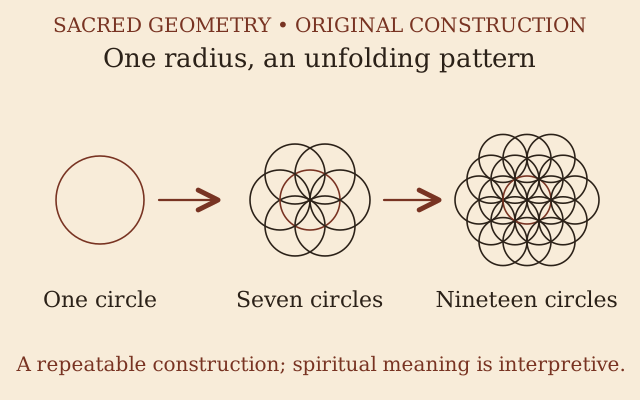
The illustration shows one circle growing into clusters of seven and nineteen. The circles use the same radius within each stage. The repeated placement produces symmetry that a reader can inspect or reconstruct. It is an original explanatory drawing, not a photograph of an ancient artefact.
That modest observation is already interesting: a small rule can generate a complex-looking whole. A further claim—that the resulting figure encodes consciousness, creates energy or explains the universe—needs a different kind of support. The geometry alone does not supply that conclusion. This distinction lets us appreciate the construction while examining the spiritual interpretation on its own terms.
Geometric art has many histories
The Ashmolean Museum describes the wide use of geometric patterns in Islamic art and architecture. Its account emphasizes how skilled makers produced complex designs from relatively simple rules. This offers a documented example of geometry’s rich artistic use without requiring the map’s particular cosmology.
A visual resemblance can be a good starting question: were two patterns made with similar tools, used for similar purposes, or transmitted between communities? Resemblance alone cannot answer those questions. In particular, a museum example of Islamic design should not be presented as evidence that its makers taught the modern Flower of Life system. Historical context is part of an object’s meaning.
A modern teaching gives the pattern a larger role
Light Technology Publishing describes Drunvalo Melchizedek’s Flower of Life material as a teaching about a creation pattern, consciousness and a proposed light body called the Mer-Ka-Ba. This is a publisher’s account of what the teaching claims, rather than an independent test of those claims. It is nevertheless a direct source for the meanings the map’s reader encounters.
The teaching also has a traceable modern circulation. The background to a 2011 federal copyright order describes workshop videos released or recorded in 1992 and 1993 and related books and illustrations. Separately, the SOLi founders describe managing Flower of Life Research from 1997 to February 2013. These records help date organisations and media; they cannot establish the asserted ancient or cosmic origin of the teaching.
From a shape to a promise of transformation
Within the map, the Flower of Life is more than a decorative motif. Read alongside sacred geometry and Merkaba, it suggests a world whose hidden structure can be understood and whose limits can supposedly be crossed through spiritual development. That is the archive’s contextual reading of the poster and the cited modern teaching.
Keep three layers in view while exploring: the construction you can draw, the historical uses of geometry that a particular source documents, and the spiritual claims made for it. Separating these layers does not erase the symbolism. It makes the symbolism easier to understand and helps avoid giving one tradition a meaning borrowed from another.
The pattern is reproducible; its cosmic interpretation belongs to a teaching. Modern records can show how that teaching circulated without proving either a universal ancient origin or a physical energy mechanism.
Continue into the map
These are related reading topics; their order does not imply an additional connection.
Flower of Life →Sacred geometry →Drunvalo Melchizedek →Merkaba / light vehicle →Sources & illustration credit
- U.S. District Court: Melchizedek v. Holt, order of 3 June 2011, background pp. 1–3Reference / research
Describes the pattern and records the dispute’s background about workshops, videos and related works. Cited for media history, not as a ruling on spiritual truth.
- Ashmolean Museum: Geometry in Islamic artReference / research
Documents geometric craftsmanship in one artistic context; it does not establish a universal Flower of Life doctrine.
- Light Technology Publishing: The Ancient Secret of the Flower of Life, Volume OneBelief / proponent source
The publisher’s description of Melchizedek’s creation-pattern, consciousness and light-body claims.
- Seed of Life Institute: Flower of Life Research historyBelief / proponent source
The former operators’ account of their 1997–2013 role and subsequent separation from the teaching.
- Champ Parinya: Great Awakening Map, English Lotus V10Belief / proponent source
The map’s combination of Flower of Life, sacred geometry and light-body themes. Their narrative role is interpreted here.
Original explanatory vector diagram created for this map. Source concepts are credited below; no source artwork reproduced.